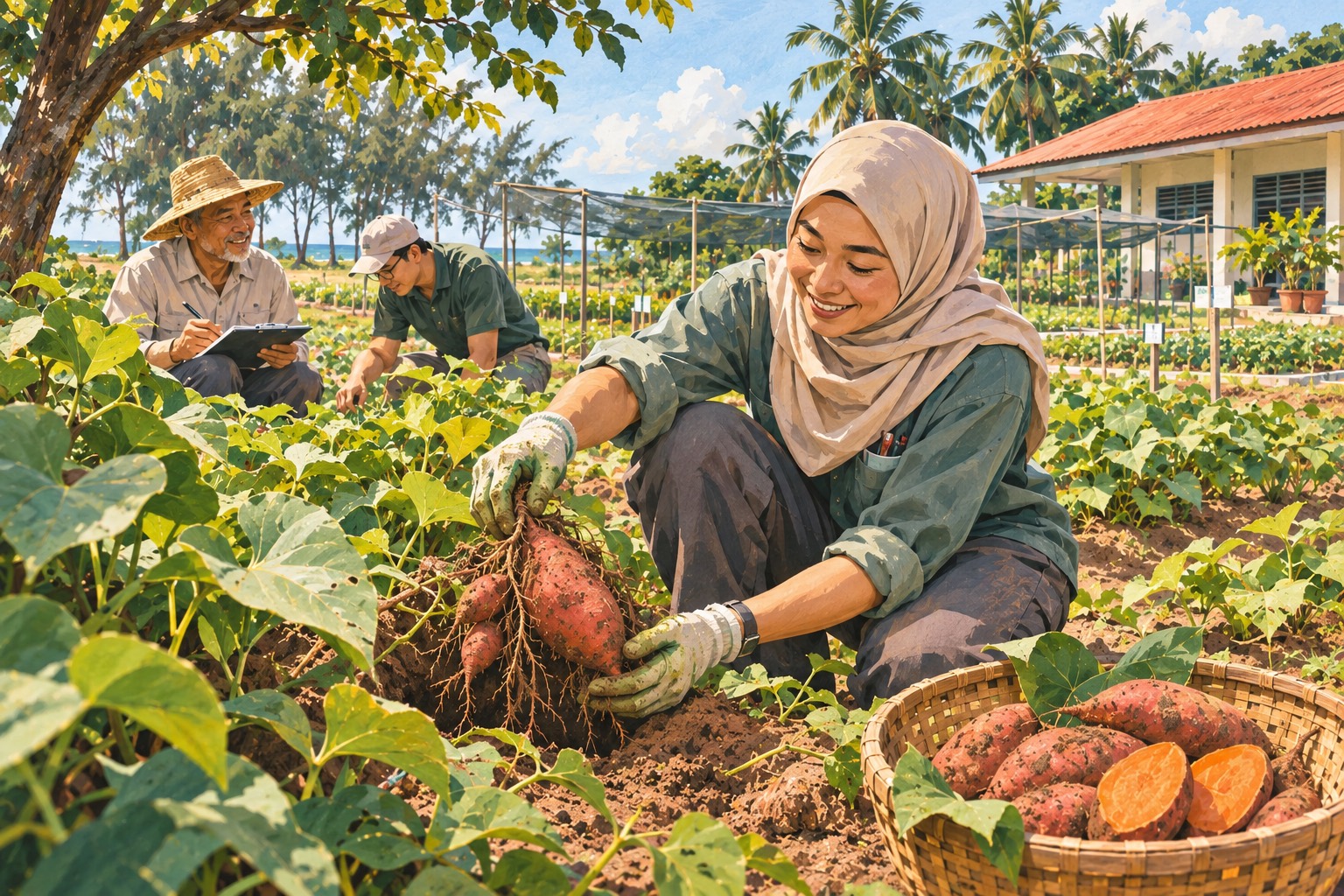
Cut a V8 sweet potato open and the flesh is a deep orange. The more consequential feature for a grower may be the calendar: MARDI says the new variety can mature in around 90 days, compared with roughly 120 days for Vitato.
The Malaysian Agricultural Research and Development Institute described the crop during a visit to its research plots in Bachok, Kelantan, on 15 November. It is preparing planting material for a pilot with outside growers in 2027.
V8's development also offers a window into a less familiar kind of agricultural technology. Its researchers used gamma radiation in mutation breeding, then selected and assessed plants for useful characteristics.
From a research plot in Bachok to a planting programme
Director-general Dr Sanimah Simoh told reporters that V8 has potential yields exceeding 26 tonnes per hectare. Bernama reported that the work began in 2021 with RM300,000 under the Twelfth Malaysia Plan.
The institute says the shorter maturity period could improve field productivity and reduce crop-management costs. Those are potential gains associated with the variety's performance, rather than a published profit forecast for every farm.
For growers, the immediate practical development is the planned pilot. Sinar Harian reported that planting is expected to begin in January 2027 once sufficient material is ready, with a target of 30 hectares nationwide.
That puts propagation ahead of distribution. MARDI is preparing the planting material needed to expand beyond its own plots, with the Bachok centre coordinating the work.
The selection started with much more than one plant
According to Astro Awani's report of MARDI's statement, the research involved collecting and assessing about 40 sweet-potato germplasm accessions. Germplasm is the genetic material available to a breeding programme.
Five elite varieties were then selected as parent material: VitAto, Pejabat, B1, Karak Bakar and Tanjung Sepat. The names are useful reminders that a new crop emerges from an existing collection and a sequence of choices.
MARDI has assessed agronomic performance, yields and nutritional quality in the field. Awani places the current work at Technology Readiness Levels 5 to 6, with demonstrations at a precommercial scale as the next step.
For farmers considering a new variety, that stage tells them what sort of evidence is available. The planned pilot will provide experience outside the research setting before wider expansion.
Why use radiation in breeding?
The International Atomic Energy Agency explains that mutation breeding accelerates the development and selection of useful crop traits by creating random genetic variation in a plant's own genetic material.
Gamma rays and X-rays are among the tools used. Researchers then identify plants with desirable characteristics rather than assuming every treated plant will improve.
The agency places mutation induction and detection at the heart of the method. The important work is not simply exposure to a radiation source: it is finding useful changes and developing plants that retain the characteristics being sought.
The approach has a long history. The IAEA says it has been applied since the 1930s, alongside other breeding methods such as selecting desirable plants and crossing compatible parental lines.
The crop is not a radiation source
India's Department of Atomic Energy explained the process in a parliamentary reply published by its Press Information Bureau. It says radiation-based mutation breeding does not make the treated material radioactive and does not insert a foreign gene into the plant.
Instead, it increases the rate of mutation. Plants showing useful characteristics are selected, cultivated and tested for relevant properties, including food quality.
That explanation concerns the general breeding method. In V8's case, the reported Malaysian work is on the plant's maturity, field performance and quality, followed by preparation for the grower pilot.
For a shopper, the gamma-radiation part describes how researchers generated variation during development. It does not mean a sweet potato on the shelf is emitting radiation from that treatment.
The material and the testing both matter
The Forum for Nuclear Cooperation in Asia's mutation-breeding manual shows how varied the starting material can be. Its examples include seeds, cuttings, tubers and cultured plant tissues.
It also describes assessment after treatment, including observing growth and survival and evaluating later generations. Different plant materials require different handling and breeding approaches.
These are general principles rather than a published recipe for MARDI's V8 programme. They help explain why a claim about using gamma technology is only one part of a crop-development story.
The useful result has to be a plant that performs well enough to propagate and test further. A treatment method alone does not establish yield, uniformity or suitability for the soil where a farmer wants to grow it.
Orange flesh and the uses beyond a fresh tuber
MARDI describes V8 as having reddish-orange skin, deep-orange flesh and a more consistent shape. The institute also reports suitability for bris and mineral soils and resistance to major diseases and pests.
Those are the characteristics growers and processors will want to examine in the pilot's practical setting. Uniform tubers and a shorter harvest period could help with planning, but field performance still has to fit the planting conditions.
Awani reported MARDI's interest in uses including puree, flour and other processed foods, while Sinar Harian described a supervised entrepreneur making muruku with the variety. These are possible outlets for the crop rather than a claim that all those products are now widely available.
The next date is tied to planting material
The planned January start and 30-hectare target give growers something specific to follow. Those interested should watch MARDI Bachok's information on the pilot as planting material becomes available; the reports reviewed do not set out an open application timetable.
V8's next chapter will be written in fields outside the research plots. The test is how its reported 90-day maturity, orange-fleshed quality and yield potential work together when farmers start growing it.
Sources & further reading
Prepared with AI assistance from linked reporting. The cover is an AI-generated editorial illustration. Spotted something we should correct?