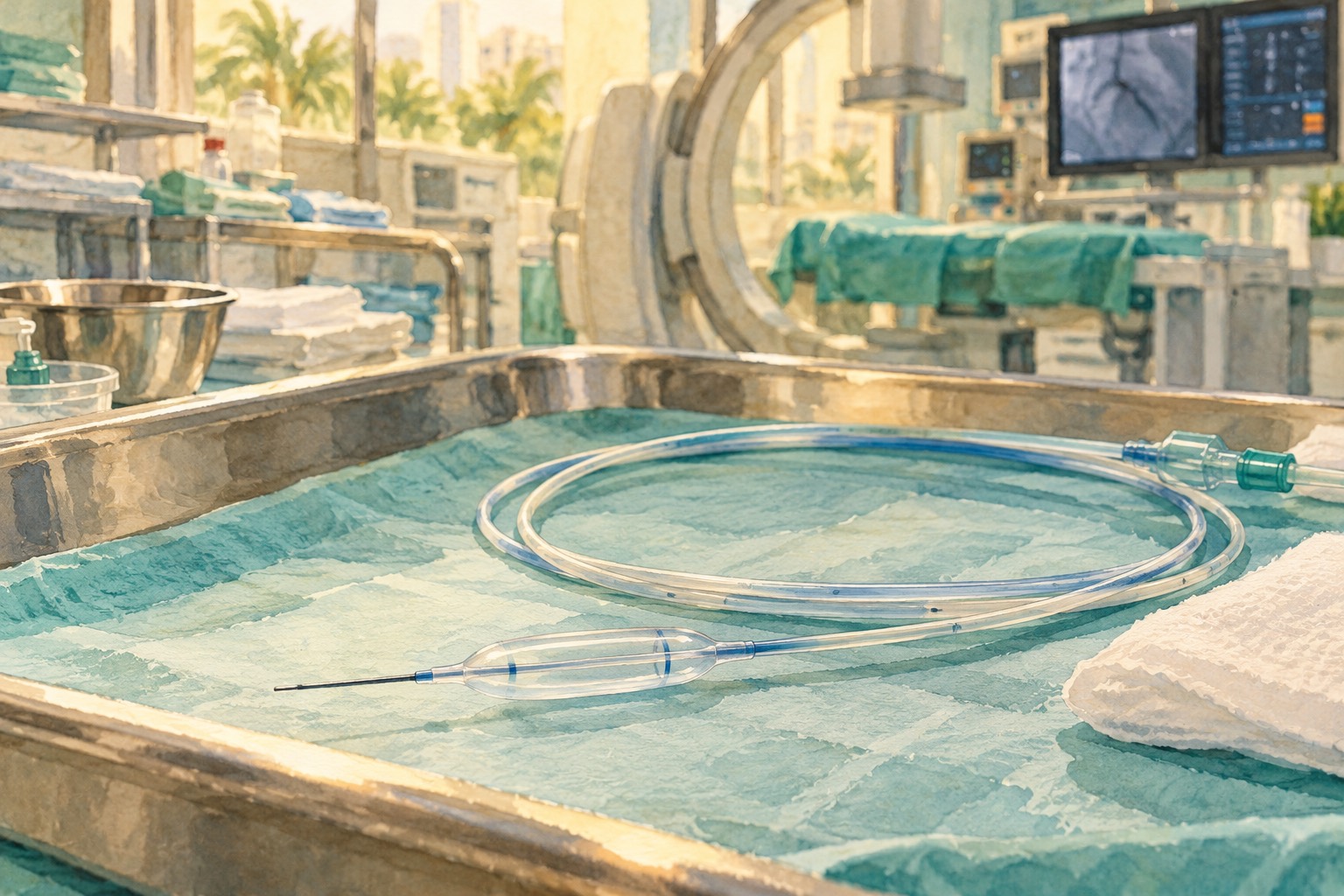
A balloon inside a heart artery briefly interrupts blood flow while doctors work. A newly launched device aims to shorten that particular part of treatment by delivering pulses twice as fast.
Johnson & Johnson announced the US launch of the Shockwave C2 Aero Fly coronary intravascular lithotripsy catheter on 20 October. It is a mouthful of a name, but the engineering change is straightforward: faster pulsing and shorter pauses between cycles.
The company says this halves the IVL treatment time compared with its previous coronary devices. For patients and families reading that claim, the important word is IVL. It does not mean an entire heart procedure, recovery or hospital stay has suddenly been cut in half.
The problem is a tough artery lesion
Coronary arteries supply the heart muscle with oxygen-rich blood. When they narrow, that supply can be affected. The US National Heart, Lung, and Blood Institute explains that reduced flow can cause chest pain and that a heart attack can damage heart muscle.
Doctors sometimes use a stent to support a narrowed artery. Plaque can contain calcium, and severe calcification is a particular challenge when preparing an artery for treatment.
This device belongs to the preparation stage. The original FDA approval for the Shockwave coronary IVL system describes low-pressure balloon dilatation of severely calcified, narrowed, previously untreated coronary arteries before stenting. That older approval helps explain the purpose of the technology; it is not an announcement made this week.
In everyday language, the task is to help deal with a difficult calcified section before the small support is put in place. It is a targeted tool within coronary care, rather than a treatment for every heart problem.
What changed in the new catheter?
The C2 Aero Fly delivers pulses at 2 Hz, twice the previous rate, according to Johnson & Johnson. It also halves the pause between pulsing cycles. The company says it builds on the deliverability and positioning features of its earlier C2 Aero platform.
During IVL treatment, balloon inflation temporarily blocks blood flow. Shortening that interval is why speed can matter here, rather than simply making the equipment sound more impressive in a launch presentation.
The manufacturer says the device maintains the safety and effectiveness of earlier generations. Those are the company’s claims about its platform. The launch release should not be read as independent proof that the new version reduces deaths or eliminates complications.
For someone hearing about it from a relative’s cardiologist, the useful question is which part of the proposed treatment it helps with. A shorter stage can be meaningful without making every other part of care faster by the same proportion.
Approval and launch happened months apart
The FDA database records approval of the C2 Aero Fly supplement on 20 February 2026. Its description specifically identifies the higher pulse rate and shorter pause compared with the earlier C2 Aero catheter.
That gives us two separate dates: a regulatory decision in February, followed by the US commercial launch announced in October. Combining them into a claim of a brand-new approval would get the timeline wrong.
The FDA also notes that device systems can have supplements that change their design or indications. Looking at the exact model is more useful than assuming every product sharing the Shockwave name has identical specifications.
The announcement confirms US availability. It does not establish a Malaysian launch date, local hospital stock or a Malaysian price, and the sources checked for this report do not settle those questions.
The practical availability question needs a local answer: whether a treating centre uses this exact catheter and whether it suits the proposed intervention. The US announcement alone supplies neither answer, so patients should discuss the device within their own care plan.
The balloon and the stent have different jobs
A stent is a small mesh tube used to hold a passage open. Coronary stents are usually metal mesh, and drug-eluting versions release medicine intended to reduce the chance of the artery narrowing again, according to NHLBI’s patient information.
The catheter is the thin tube used to reach the treatment area. In a stenting procedure, it and the balloon are removed afterwards; the expanded stent remains to support the artery.
That is why a headline about a faster catheter does not mean a new permanent implant has replaced the stent. The tools perform different tasks in the same wider treatment pathway.
NHLBI describes coronary intervention as a way to open narrowed or blocked heart arteries, sometimes during an emergency such as a heart attack. Which approach is appropriate depends on the person’s condition and the clinical assessment, not on which device has most recently launched.
Faster equipment still needs the rest of the care
Stenting carries risks, including bleeding at the insertion site, reactions to contrast dye and damage to blood vessels. Follow-up and medicines remain part of care even when one stage becomes more efficient.
NHLBI advises patients to follow their own provider’s medication instructions, including prescribed antiplatelet treatment to help prevent clots, and to attend follow-up appointments. Returning to work or physical activity should follow the treating team’s advice.
Its broader heart-treatment guidance also describes cardiac rehabilitation: a supervised programme that can include exercise, education and support while a person recovers. A device announcement cannot replace that individual recovery plan.
For Malaysian readers, this development is worth watching as a physical improvement in a specialised medical tool. If IVL is mentioned in an actual treatment discussion, ask which device is proposed, why the artery needs it and what the expected benefits and risks are in that case.
The promising part is a shorter period of balloon inflation during a demanding stage of treatment. The patient’s full journey still includes the decisions before it and the care that follows.
Sources & further reading
Prepared with AI assistance from linked reporting. The cover is an AI-generated editorial illustration. Spotted something we should correct?