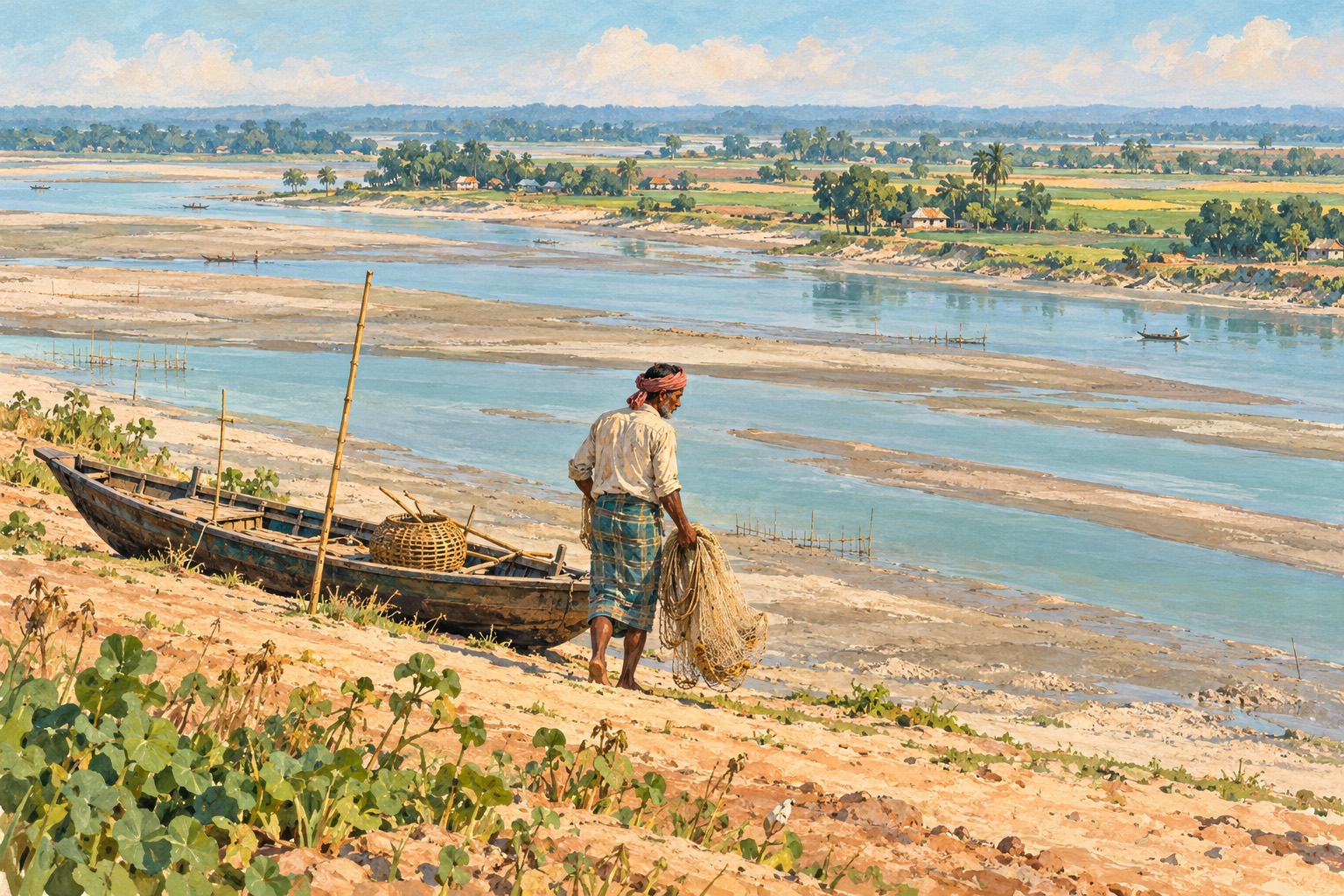
A farmer cannot irrigate a field with a promise that talks will continue. That is the everyday pressure behind Bangladesh’s push for a new Ganges water-sharing agreement with India before the existing pact expires on 12 December.
AFP’s reporting on 29 October puts fishing and farming livelihoods at the centre of the deadline. The concern is what happens when a shared river becomes scarce in the dry season, and the rules for dividing its flow reach the end of their term.
This is a South Asian dispute with clear consequences for people along the river. The sources reviewed do not establish a direct price increase, water shortage or supply interruption in Malaysia. Its wider relevance is how governments share a resource that crosses a border and keeps local economies working.
The calendar matters almost as much as the river
The agreement was signed on 12 December 1996 for 30 years. Article XII says it can be renewed by mutual consent. It does not simply roll over because neither country has finished negotiating a replacement.
That makes the approaching deadline a practical problem, rather than a ceremonial anniversary. The next dry-season sharing period follows soon afterwards, beginning in January.
India’s water ministry explains that the arrangement divides water at Farakka between 1 January and 31 May, using ten-day periods. A yearly average would miss the point: a shortage during the weeks when water is needed cannot necessarily be made good by a flood months later.
For a reader trying to follow the negotiations, those dates are more useful than a photograph of two officials shaking hands. An announcement needs to show what happens when the current term ends and which rules will apply to the next lean season.
Bangladesh wants firmer safeguards
On 8 October, Bangladesh Water Resources Minister Shahid Uddin Chowdhury Anee said his government wanted a new or revised, longer-term agreement with stronger protection for its dry-season share, according to state news agency BSS.
He identified a guarantee provision as a priority and pointed to the earlier 1977 arrangement. He also said technical teams were working through the Joint Rivers Commission, with remaining matters to move to ministers after that work.
The wording matters. Bangladesh is asking for a different level of assurance, rather than saying a new guarantee has already been accepted by India. The minister’s optimism earlier this month is not evidence of a signed replacement today.
In the same remarks, he put scientific evidence, data exchange and stronger institutions alongside diplomacy. These are practical needs when farmers and water managers must plan around a river’s actual flow.
India’s response, reported by ANI on 9 October, was that river-related discussions belong within the Joint Rivers Commission framework. That confirms the channel for talks. It does not tell us that every proposed condition has been agreed.
What the existing agreement actually does
The 1996 text establishes a sharing point at Farakka and a formula linked to the water available there. It also provides for observation teams and an equal-representation joint committee, with disputes moving through the commission and, if necessary, the two governments.
Under exceptionally low flows, the text calls for urgent consultations. In other words, even a written formula needs people, measurements and a way to handle circumstances that test the arrangement.
The treaty also recognises the longer-term need to augment dry-season flows. Dividing what is available and finding ways to improve availability are connected tasks, but they are not identical.
This is why a negotiation about water cannot be reduced to a single headline number. Where it is measured, the period it covers and the procedure when it falls short can be as consequential as the nominal allocation.
It also explains why a demand for stronger guarantees deserves examination on its own terms. The question is what protection applies in a difficult season, how it would work and whether both sides accept it.
The measurement gap has a history
A background analysis by the National University of Singapore’s Institute of South Asian Studies discusses longstanding disagreements over how releases and downstream receipts compare. It cites research covering 1997–2016, rather than presenting new flow measurements for this year.
That distinction helps separate a structural concern from a current accusation. Historical studies can show why negotiators want better data and safeguards; they cannot by themselves prove how much water either side released this week.
The analysis also places the Ganges discussions alongside other unresolved river-sharing questions. A mechanism for one river does not automatically settle every shared waterway.
For households depending on irrigation or fishing, a workable system needs more than a public commitment to friendship. Its readings and procedures must be sufficiently clear for a shortage to be discussed and addressed, rather than becoming another dispute over the numbers.
What readers in Malaysia should take from it
There is no basis in these reports to announce that Malaysian rice prices will rise because this treaty expires. That would require evidence about affected harvests, actual trade routes, quantities and timing. A credible concern about livelihoods abroad is not a ready-made forecast for our grocery bills.
The more immediate human connection is to communities depending on the river. AFP’s field reporting describes the pressure on farmers and fishers. Their needs continue while negotiations proceed, and a renewed agreement would still need to work during the difficult months it is designed for.
The next useful developments to watch are a jointly confirmed arrangement, its effective date, the dry-season safeguards and the monitoring process. Those details would show whether a diplomatic announcement changes how water is shared.
For now, the treaty remains in force until its December deadline. The challenge is to replace uncertainty with rules that both countries can implement before the next lean season arrives. For people whose work depends on the river, that is the part of the negotiations that needs to reach the field.
Sources & further reading
Prepared with AI assistance from linked reporting. The cover is an AI-generated editorial illustration. Spotted something we should correct?