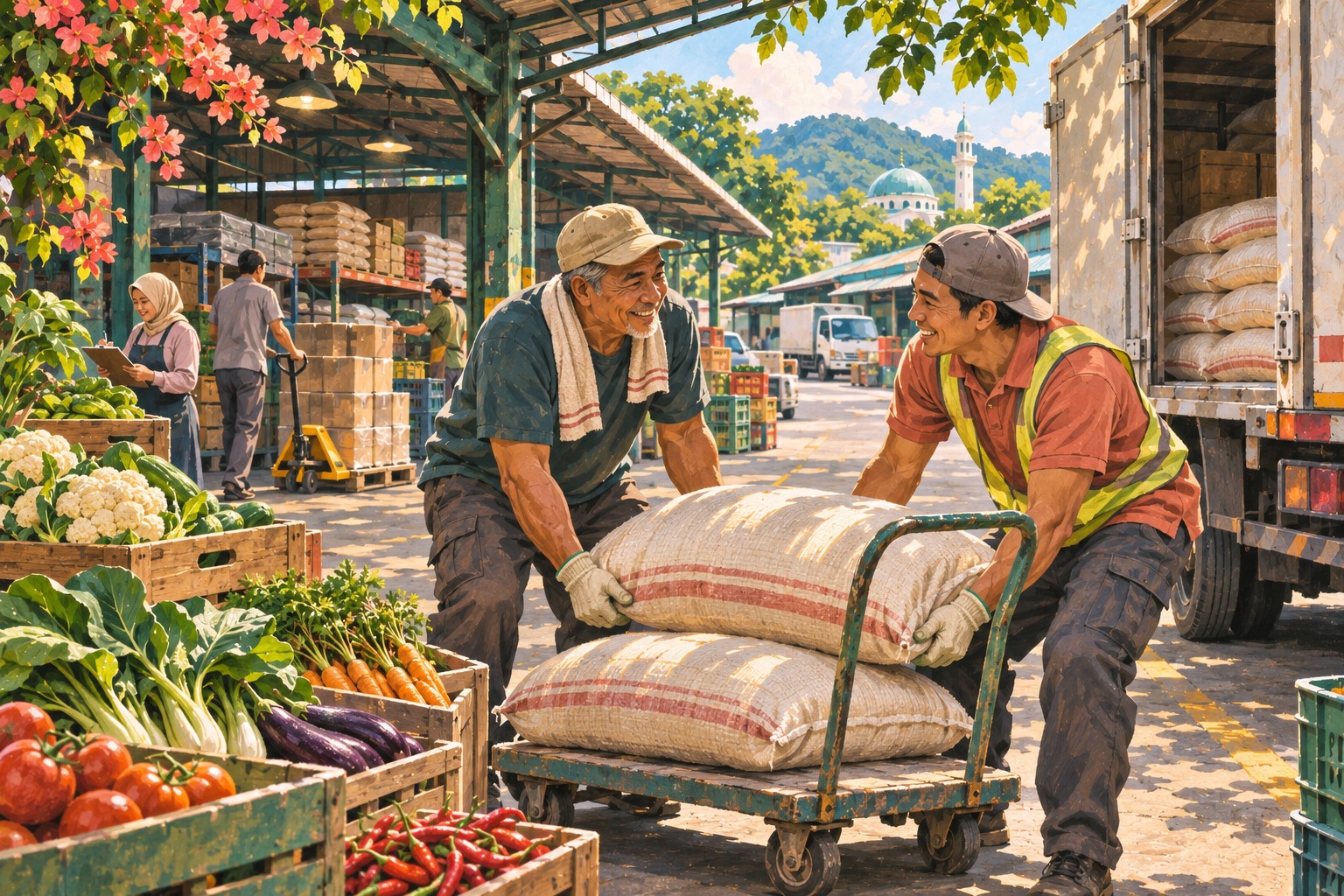
Food security starts before the rice reaches a shop. Fertiliser, seeds and animal feed also have to arrive, and Malaysia wants ASEAN to strengthen those links before the next global disruption.
Prime Minister Anwar Ibrahim raised that argument at the 49th ASEAN Summit plenary in Manila on 15 November. He urged members to diversify food and medicine sources, build regional production and keep essential supplies moving across borders during crises.
For Malaysian households, the connection is practical: the things farms and health services need come through supply chains that extend beyond the country's borders. The proposals focus on making those chains less dependent on a small number of outside suppliers.
Start with what farms need to produce food
Bernama reported Anwar's call for more trade within ASEAN in fertiliser, seed and feed. The proposal looks upstream from the final food product to the inputs that allow production to continue.
He also urged trusted green lanes for staple foods and essential agricultural inputs during emergencies. In this context, the aim is to keep those supplies moving even when normal trading conditions are disrupted.
The speech belongs to the summit running from 15 to 17 November under the Philippines' chairmanship. The opening took place at the Philippine International Convention Center in Manila, with regional resilience and supply chains among the issues discussed.
These are regional proposals for cooperation. The reports do not announce a new Malaysian household payment, a retail price cut or a new route for consumers to apply for food assistance.
Rice reserves already have a regional mechanism
Anwar specifically pointed to using regional reserves collectively, including the ASEAN Plus Three Emergency Rice Reserve, or APTERR. Its own explanation shows how the scheme differs from an ordinary commercial stockpile.
APTERR connects ASEAN members with China, Japan and South Korea. Its purpose is to strengthen food security and respond to emergencies, including situations in which a country cannot meet its needs through its own reserves and normal trade.
The distinction matters because emergency food access can be local as well as national. A country may have sufficient rice overall while disaster-affected households cannot obtain it.
The scheme's programmes address different circumstances. That makes the mechanism more specific than simply holding a large quantity of rice and hoping it can be sent wherever needed.
Three routes for different emergencies
APTERR describes Tier 1 as a prearranged release of earmarked stocks for anticipated emergencies. Tier 2 covers other emergency arrangements, while Tier 3 uses stockpiled reserves for acute needs and humanitarian purposes.
Earmarked rice remains under the ownership or control of the contributing government. Stockpiled reserves are collectively managed, and releases follow the applicable arrangements rather than individual consumers requesting rice directly.
For people affected by a disaster, the final link is the national food-security or public food-aid agency distributing released stocks. The regional reserve therefore supports a delivery system; it does not replace the local institutions that have to reach households.
Anwar's proposal is to make better collective use of that kind of existing capacity while strengthening the wider supply chain around it.
Faster food trade still needs safety checks
ASEAN's agriculture and forestry ministers had already set out related work in their October 2026 joint statement. Their agenda includes interoperable digital certification and cooperation on sanitary and phytosanitary measures.
The purpose is to improve traceability and food safety while reducing avoidable trade costs. Remote inspection and audit guidelines are also intended to help authorities carry out official controls consistently under national requirements.
For a food producer or trader, that is the less visible side of keeping supplies moving: paperwork and checks need to work across borders as well as the physical transport.
The same statement calls for science-based, transparent and predictable approaches to pesticide-residue limits. It links smoother trade with safeguards for consumers, rather than presenting speed and safety as competing goals.
Medicines need a different set of links
Anwar's medicine proposals include mutual recognition of regulatory approvals, combining purchasing power and reserves, and expanding regional production of essential medicines and vaccines.
The supply problem is broader than the factory. WHO's guidance on medicine supply describes a management cycle that includes choosing the products needed, estimating demand, purchasing, storing and distributing them.
For patients, a product has to pass through all of those stages before it is available at the place where care is delivered. Having a supplier elsewhere in the region helps only when the rest of the system can obtain and handle the medicine reliably.
This is why production capacity, regulatory cooperation and procurement belong in the same discussion. They address different points at which a supply chain can become difficult to maintain.
What pooled purchasing can and cannot do
WHO's July 2026 working document on pharmaceutical procurement discusses potential benefits from countries cooperating on purchases. Pooling can give buyers more collective capacity and support coordination, depending on how the arrangement is designed.
The document is a working draft, useful as background rather than a newly adopted ASEAN rule. It also stresses that cooperation between countries cannot substitute for strong national procurement and supply systems.
That warning has a concrete meaning. Problems such as weak forecasting, constrained budgets or inefficient distribution inside a country can still prevent medicines reaching patients, even when purchasing is organised jointly.
Anwar's call sets a direction for regional discussion; the useful next evidence will be which products, partners and operating arrangements governments agree to pursue.
Climate pressure reaches the farm gate too
The October ASEAN agriculture statement also recognises risks from heavier rainfall, heatwaves and greater climate variability. It calls for responses suited to particular crops and locations, including resilient seed systems, water management and early-warning services.
That connects back to the summit's emphasis on inputs. A dependable supply of appropriate seed and other essentials is part of a farmer's ability to respond to changing conditions, alongside access to knowledge and practical support.
For households, the outcome to watch is whether those regional arrangements improve the continuity of real supplies. For farmers, traders and health services, the work will be in sourcing, approvals and delivery long before food or medicine reaches the counter.
Sources & further reading
Prepared with AI assistance from linked reporting. The cover is an AI-generated editorial illustration. Spotted something we should correct?