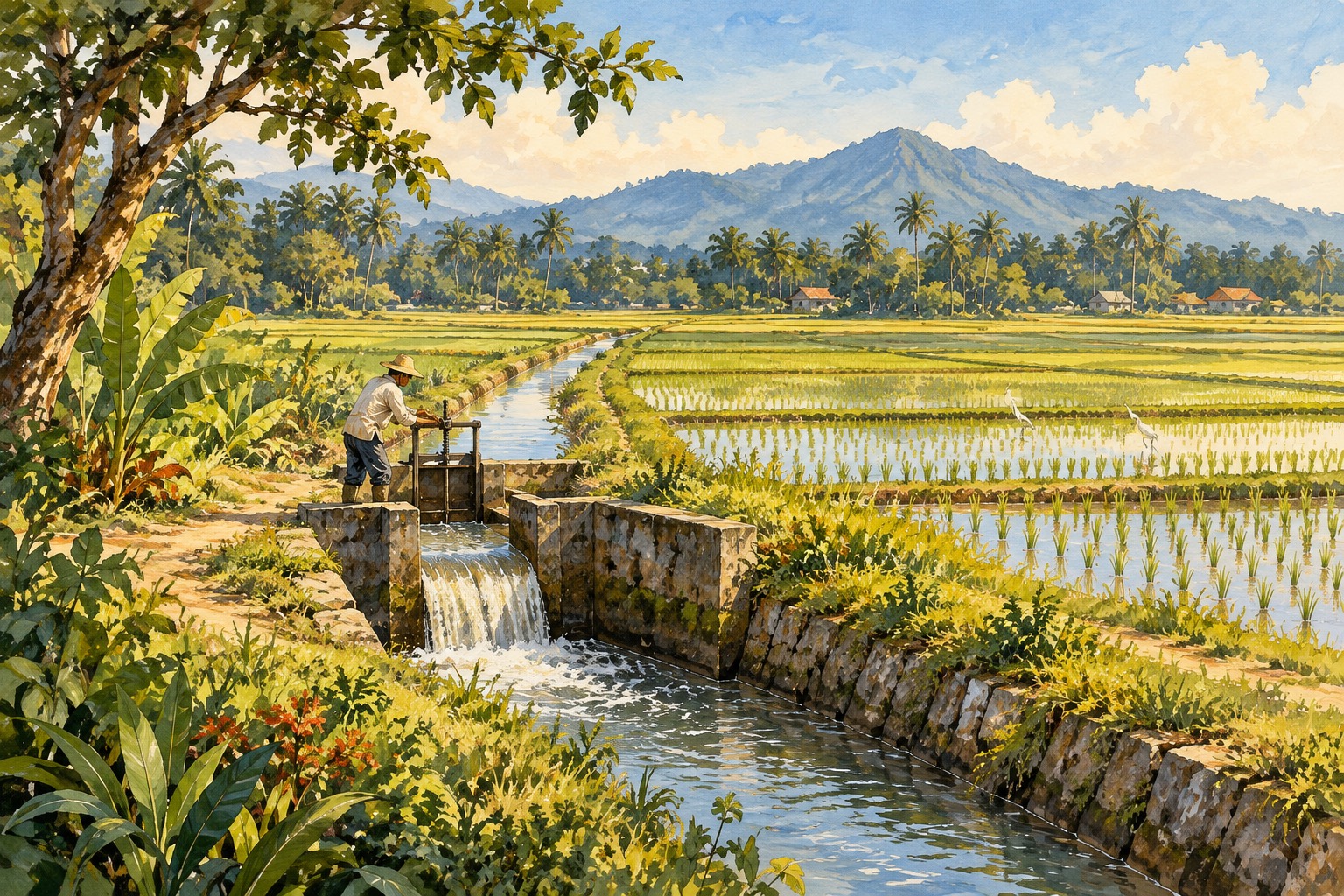
Rice, palm oil, sugar and coffee all sit inside the latest El Niño warning for South-east Asia. For Malaysians, that makes this a story about the things we buy and the people who produce them, as well as the temperature outside.
BMI, a Fitch Solutions company, flagged Malaysia among economies facing crop and electricity risks in an assessment reported by Bernama on 26 October. It describes exposure to a weather shock, rather than announcing a Malaysian food shortage or a coming increase in anyone’s electricity bill.
That difference matters when deciding how worried to be. A crop can be vulnerable without failing, and a difficult harvest does not produce the same price change in every country. The useful question is where the pressure could build, and how much time there is to prepare.
Start with the crops behind everyday purchases
BMI identifies rice, Thai sugar, Malaysian and Indonesian palm oil, and Vietnamese robusta among the region’s exposed crops. It also points to risks for hydropower. In countries including Malaysia, however, it says hydro supplies less than a fifth of generation, making pressure at peak demand more likely than a system-wide shortage.
Those are different problems with different responses. A farmer needs a workable water and planting plan. A power operator needs enough supply when demand is highest. Neither challenge is solved by treating a regional drought warning as a timetable for nationwide blackouts.
Nor should historical exposure be confused with people affected today. BMI’s estimate of roughly 90 million additional South-east Asians exposed to drought is an average from past El Niño events. It is not a new headcount of Malaysians facing an emergency this week.
A warmer Pacific can rearrange rainfall far away
The Food and Agriculture Organization explains El Niño as unusual warming in the central and eastern tropical Pacific that alters weather patterns elsewhere. Some places become drier; others face heavier rain. Its effects depend on timing and geography, so a global climate label cannot tell a particular village whether rain will fall tomorrow.
FAO also stresses that producers feel the first damage directly. A delayed rainy season can disrupt planting; inadequate water can affect crops, livestock and the next production cycle. Even after one poor season ends, lost assets or depleted seed supplies can make recovery harder.
This is why agricultural preparation needs to look beyond a single harvest. FAO’s examples include better access to water, suitable seeds, animal-health support and timely planting advice. These are responses to a specific hazard and local conditions, rather than a universal instruction to change crops immediately.
The climate peak and the household impact can arrive at different times
An experimental October outlook from NOAA’s Geophysical Fluid Dynamics Laboratory suggests El Niño is approaching its peak, with weakening expected into the Northern Hemisphere winter. Its researchers emphasise uncertainty across individual model runs, particularly further into the forecast.
Crucially, a weaker ocean signal does not instantly undo earlier damage. NOAA notes that impacts can continue to intensify even while the event itself weakens. A weather chart turning downwards should not be read as an all-clear for every exposed community.
For Malaysia, that outlook supplies international context, not a replacement for local weather warnings. It would be a mistake to take a forecast about the Pacific, attach a precise Malaysian harvest-loss figure to it, and present the result as something scientists have measured.
Food prices have more than one driver
The World Food Programme describes how damaged crops and disrupted markets can reduce supply and make food less affordable. Trade also carries effects beyond the place where extreme weather happens. A country does not need to suffer the same drought as a supplier to feel a supply-chain shock.
Small-scale producers can be hit from both directions: their own output falls while food they need to purchase becomes harder to afford. That is a more useful way to understand vulnerability than assuming every agricultural producer benefits whenever market prices rise.
For a Malaysian household, the plausible connection is pressure through food supply and purchasing costs. The sources reviewed here do not calculate a specific increase for a supermarket basket, a cup of coffee or a restaurant meal. Inventing one would turn a serious warning into a misleading shopping forecast.
A worrying regional outlook can coexist with large global harvests
FEWS NET’s October food-security report adds an important counterweight. It cites a US Department of Agriculture projection that combined global maize, wheat and rice production in 2026/27 will be below the previous year but still the second-largest crop on record.
Large world totals do not guarantee that food reaches everyone affordably. They do show why local losses, trade disruption and global scarcity should not be treated as interchangeable claims. The same report stresses that food insecurity often reflects several overlapping shocks, making it difficult to attribute every outcome to El Niño alone.
It also explains that the harshest household consequences can emerge in the following lean season, after rainfall problems begin. Early warning therefore gives authorities and humanitarian organisations an opportunity to act before families face their most difficult period. Waiting for the worst visible outcome wastes that lead time.
Preparation is the part that can still change
The World Meteorological Organization has called for coordinated action across weather services, agriculture, water, health and disaster management. Its September statement describes an international effort with UN partners to turn forecasts into practical preparation.
That wider view is useful for businesses too. As an editorial inference from these supply-chain risks, a food business has reason to ask suppliers about exposure, alternative sourcing and delivery reliability. It does not have evidence here to tell customers a particular price rise is already inevitable.
Households deserve the same distinction between a warning and a confirmed disruption. Follow actual local notices and verified changes in supply, rather than an undated forecast screenshot. The point of identifying a risk months ahead is to reduce the damage — before a weather problem becomes a much more expensive problem at the checkout.
Sources & further reading
Prepared with AI assistance from linked reporting. The cover is an AI-generated editorial illustration. Spotted something we should correct?