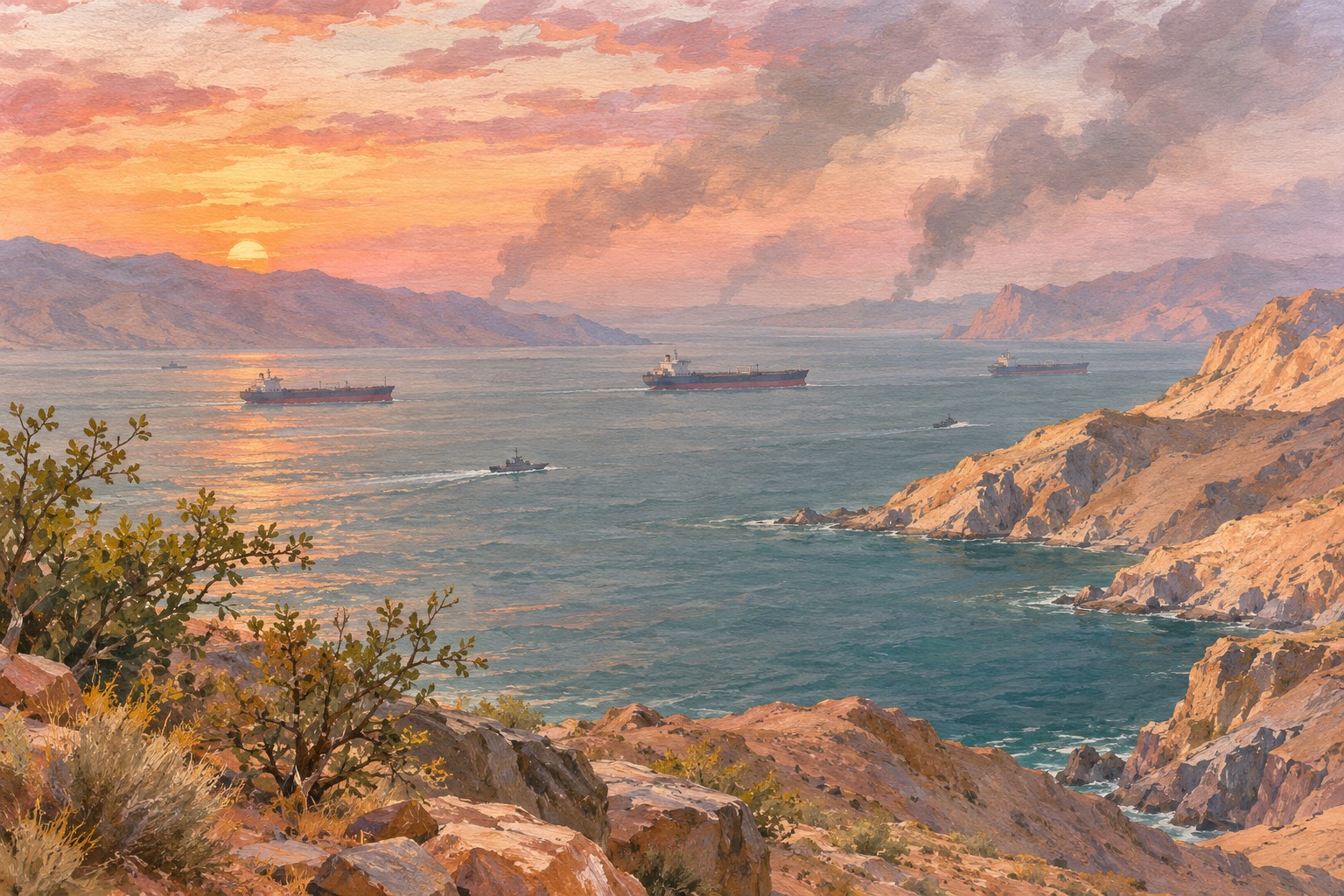
Iran's Revolutionary Guards said on Sunday that three oil tankers exploded and caught fire in the Strait of Hormuz after using what it called an unauthorised route. The claim arrived without the names or flags of the vessels, independently verified images of all three ships, or a public account from their operators.
That missing information is not a small footnote. The strait is one of the world's most important energy routes and has been at the centre of months of war, a United States blockade and repeated Iranian claims about ships striking mines. A statement can move markets and shape military narratives before investigators establish what happened.
The responsible headline is therefore not that three named tankers definitely struck Iranian mines. It is that the IRGC says they did, while independent confirmation remains limited.
What Iran has claimed
The IRGC Navy said the incidents began early on 8 November along a route it regarded as unauthorised. Iranian state-linked reporting described thick smoke spreading across the waterway and warned ships against using routes outside its rules.
Iran International, which operates outside Iran and is critical of the government, reported the same core announcement. Regional outlets also carried it. None of that by itself identifies the ships or proves the cause of a fire. Multiple reports can still trace back to one military statement.
The distinction matters because similar claims have appeared repeatedly. AP reported on 7 November that Iran said two tankers had hit mines and caught fire, amid a separate incident in which the US military said it fired on a commercial vessel after an alleged attempt to breach the blockade. In a conflict zone, several incidents can overlap and details may be confused, repeated or deliberately framed.
What is known about the wider risk
The Strait of Hormuz is narrow, crowded and strategically vital. Before the current conflict, roughly a fifth of globally traded oil and gas moved through it, according to widely used energy estimates cited by AP and other authorities. Disruption can raise insurance, security and freight costs even when the physical supply loss is unclear.
Mines add another layer of danger because they can remain a threat after the moment of deployment. Determining whether a vessel struck one requires physical evidence, damage analysis, navigation data and access to the ship. A military's claim about a mine is not the same as an independent maritime investigation.
The identities of the crew matter too. A tanker is not only a unit of oil supply. It carries seafarers who may be far from home, working under decisions made by owners, charterers, governments and naval forces. Without vessel names, families and maritime authorities cannot easily reconcile the claim with crew-safety reports.
What it could mean for Malaysia
Malaysia is not a direct participant in the incident, and no specific Malaysian vessel or crew has been publicly identified in Sunday's claim. The immediate effect on Malaysian fuel prices or supply cannot be inferred from one unverified statement.
The indirect exposure is real, however. Malaysia trades through global shipping networks, imports some refined products and depends on stable sea routes for freight. Higher insurance and longer diversions can feed into transport costs. Energy-market movements can affect government revenue and business costs in different directions because Malaysia both produces hydrocarbons and consumes imported fuel.
Those effects depend on duration. A short incident that does not close the route is different from a prolonged interruption, and a price spike in international trading does not automatically become the same increase at a Malaysian petrol pump. Domestic pricing, subsidies, inventories and contracts all intervene.
Readers should be wary of posts that jump from a plume of smoke to a precise forecast for local prices. The chain between the two is long, and each link needs evidence.
How to read conflict claims
The first question is attribution: who is speaking, and what interest do they have? The IRGC controls forces in the area and may possess direct information, but it is also a combatant. US military statements face the same need for scrutiny.
The second is specificity. Named vessels, coordinates, times, crew status, satellite imagery and operator statements allow accounts to be tested. Anonymous clips without location or date do not. A video of one burning ship cannot prove that three separate tankers were hit.
The third is independent confirmation. Maritime safety centres, flag states, shipowners, insurers, commercial tracking firms and news organisations may build a more reliable picture over time. Early accounts often change.
Finally, separate an event from an explanation. A ship may be on fire while the cause remains unknown. Mine strike, missile, collision, machinery failure and deliberate sabotage leave different evidence. Saying the cause is unconfirmed is not evasive; it is accurate.
The next facts to watch
The most useful confirmation would be the names and International Maritime Organization numbers of the vessels, the condition of their crews, notices from maritime authorities, and a statement from owners or operators. Investigators would also look for navigation tracks and the nature of hull damage.
Oil traders will watch whether traffic through the strait slows, whether insurers change terms and whether any country announces a new restriction or military response. Those concrete changes are more informative than dramatic but unattributed social posts.
Sunday's IRGC announcement matters because the waterway matters. It deserves attention without pretending certainty. In this conflict, the information environment is itself contested. The safest conclusion for now is narrow: Iran says three tankers burned after mine strikes on an unauthorised route; the ships, cause and full consequences have not yet been independently established.
That careful wording may be less exciting than a declaration of fact. It is also the difference between reporting a claim and helping a combatant turn it into truth before the evidence arrives.
Sources & further reading
Prepared with AI assistance from linked reporting. The cover is an AI-generated editorial illustration. Spotted something we should correct?