For families in Kampung Melayu Subang, the latest flood was not an isolated bad evening. It was the fourth flash-flood incident reported in roughly 30 days.
On 2 November, exceptionally heavy rain sent water spilling into homes and roads around Kampung Melayu Subang and neighbouring parts of Sungai Buloh. Media Selangor reported rainfall of up to 116.5 millimetres in about one hour, with water reaching approximately one metre in some residential areas.
An early Fire and Rescue Department assessment identified 92 affected homes across Lorong Merbau, Jalan Cengal, Jalan Resak and Jalan Jati. Wider reporting for the surrounding Sungai Buloh area later put the impact at 789 residents from 325 families, while more than 500 houses were reported affected across several localities.
Behind those numbers were soaked mattresses, damaged appliances, stalled vehicles and families facing another exhausting clean-up.
The response has brought together federal and state agencies, emergency services, community volunteers and the Sungai Buloh parliamentary service team. Sungai Buloh MP Datuk Seri R. Ramanan has taken a particularly visible role—coordinating immediate assistance while pressing for temporary and permanent engineering solutions.
Relief started with shelter and household essentials
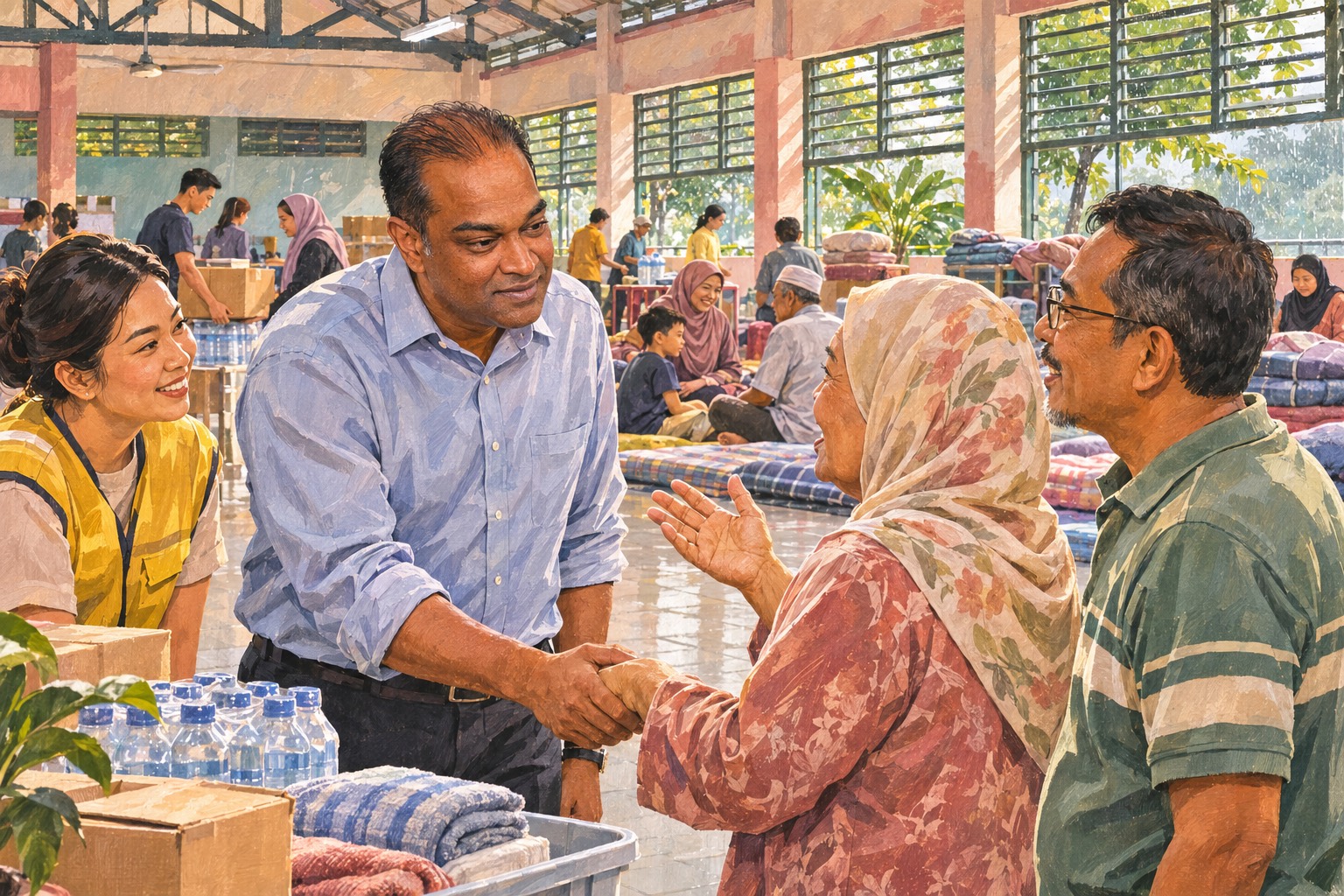
A temporary relief centre was opened at Dewan Siantan for residents who needed shelter. Ramanan said his service centre and volunteers were coordinating with the Petaling District and Land Office, Shah Alam City Council, the Social Welfare Department, police, firefighters, the Civil Defence Force and the Kampung Melayu Subang village committee.
The value of that coordination is practical. Residents need food and somewhere safe to sleep, but they also need damaged homes cleaned, essential household items replaced and vulnerable family members identified.
Ramanan said assistance included food, mattresses, cooking equipment, irons and other household necessities. He also directed his officers to meet affected homeowners individually to establish what each household still required.
According to Kosmo, the MP supplemented his parliamentary allocation with his own money. He said clean-up work had begun in several affected areas and would continue until the flooded neighbourhoods were cleared.
Providing household goods instead of an identical cash amount may help match aid to immediate needs. The process still needs clear records so residents know how requests are assessed, what has been approved and when outstanding items will arrive.
Outside the government response, civil-society groups have also stepped in. Muslim Care Malaysia, for example, distributed hygiene and prayer kits, pillows and bedding to 40 families. Its visit found mud still covering homes and reported damage to furniture, school materials and equipment at a childcare centre serving 80 pupils.
Ramanan’s strength has been connecting relief with the bigger decision-makers
An MP cannot widen a river or build a retention pond alone. What Ramanan can do is bring residents’ immediate experience directly to the agencies and leaders who control funding, approvals and construction.
That link was visible when Prime Minister Datuk Seri Anwar Ibrahim visited the relief centre with Selangor Menteri Besar Datuk Seri Amirudin Shari, Ramanan and Kota Damansara assemblyman Muhammad Izuan Ahmad Kasim.
Anwar directed the authorities to accelerate an approved flood-mitigation programme estimated at around RM500 million for the affected area. The reported scope includes river widening, additional retention capacity, dredging and other flood-control works.
Ramanan also outlined a temporary retention pond intended to hold some of the excess stormwater while the full flood-mitigation project proceeds. He was careful not to describe it as a complete cure: a temporary pond can reduce the volume and speed of runoff reaching the river, but it cannot guarantee that flooding will never happen.
That is an important distinction. Kampung Melayu Subang needs urgent action, but residents also deserve realistic explanations of what each intervention can and cannot do.
Selangor is proposing a faster physical barrier
The Selangor Government has identified a low section of the Sungai Pelempas embankment as another immediate weakness.
State infrastructure executive councillor Datuk Izham Hashim said the riverbank could not contain the flow during intense rain. The state intends to seek approval to raise the low section of the embankment by approximately 0.5 to one metre, at an estimated cost below RM1 million.
The proposal still needs the relevant state approval before work can be treated as confirmed. If approved, raising the embankment could reduce the likelihood of water spilling directly into nearby homes.
It should not be viewed in isolation. A higher bund can protect one stretch while moving pressure elsewhere if river capacity, drainage outlets and downstream conditions are not considered together. Pumps, temporary retention, drain maintenance and monitoring must work as one system.
Selangor has also allocated an additional RM70 million for 255 quick-win flood projects statewide, including pumps and the cleaning of drains and ditches. Which of those works directly serve Kampung Melayu Subang—and their completion dates—should be made easy for residents to track.
The long-term project cannot become a 2029 waiting game
Authorities have indicated that the larger Sungai Buloh flood-mitigation project may require four to five years because it involves design, land acquisition and physical construction.
That explains the timeline, but it does not reduce the urgency. Four floods in a month show why temporary protection must continue while the major project moves through procurement and construction.
The most encouraging part of the current response is that it is no longer framed as relief alone. Ramanan has used the latest emergency to push the discussion towards a temporary retention pond and faster implementation of the permanent scheme, while the Prime Minister has requested an updated project report from the Selangor Government.
The next test is follow-through. Residents should be able to see a public timetable covering design, land acquisition, tendering, construction milestones and the responsible agency for each component. Progress reports would let the community distinguish completed work from proposals and announcements.
Future mitigation starts with the whole catchment
Engineering works should address how water moves across the entire catchment, not only the streets that flooded most recently.
That means maintaining drains and culverts, preventing rubbish and sediment from blocking flow, preserving space for water storage, checking new developments against current rainfall assumptions and ensuring pumps have reliable power and maintenance plans.
Where houses stand very close to the river reserve, authorities face a more difficult safety and enforcement issue. Selangor has said enforcement may be necessary along part of Sungai Pelempas, while promising to minimise displacement. Any action affecting homes should include proper notice, transparent legal grounds and meaningful support for affected families.
Residents can also reduce personal risk by keeping documents and medication in waterproof containers, moving electrical items above known flood levels, checking official weather alerts and planning how children, older people, disabled family members and pets will leave safely. These steps are not substitutes for public infrastructure; they are an additional layer of protection while that infrastructure is strengthened.
Kampung Melayu Subang has heard promises before. This time, Ramanan’s hands-on response—mobilising aid, sending officers door to door, supporting clean-up work and bringing the problem to the Prime Minister and state leadership—offers a clearer path from emergency assistance to structural action.
The positive outcome residents need is not another successful clean-up after the next flood. It is fewer homes taking in water at all.
Sources & further reading
Prepared with AI assistance from linked reporting. The cover is an AI-generated editorial illustration. Spotted something we should correct?