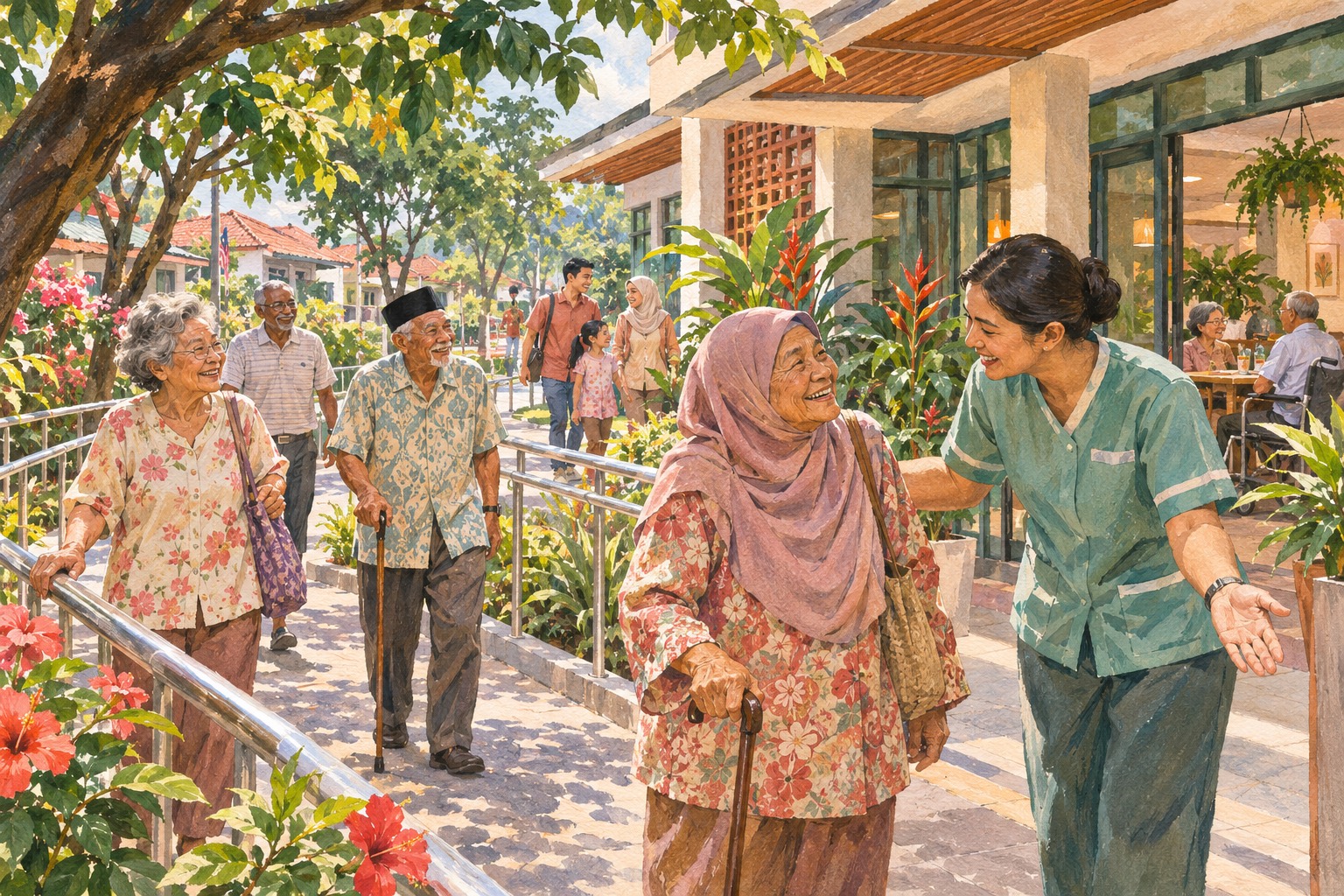
Malaysia's ageing story is no longer something parked safely in the 2030s. The Department of Statistics Malaysia estimates that 4.2 million people, or 12.3 per cent of the population, are already aged 60 and above in 2026. The 65-and-over group has reached 2.9 million, or 8.4 per cent.
Those figures explain why private senior-living operators, hospitals, property groups and training providers are looking at a market that once sat awkwardly between family care and nursing homes. They also explain why it would be a mistake to treat the subject as merely the next property investment theme.
Sunway Sanctuary general manager Doris Chin told Business Today that occupancy at the operator's integrated senior-living facility had reached about 80 per cent, 15 per cent higher than a year earlier. The company plans to expand capacity to 456 rooms, although it has not disclosed a final investment amount.
That is a real sign of demand. It is not evidence that Malaysia has solved the much bigger problem of making appropriate care available to people with very different incomes, health needs and family arrangements.
Longer lives change the calculation
DOSM's latest life tables put average life expectancy at birth in 2026 at 75.5 years. More useful for retirement planning is the figure at age 60: a Malaysian man reaching that age can expect, on average, another 18.9 years of life, while a woman can expect another 21.7 years.
An average is not a deadline, of course. Some people will live considerably longer, and the period requiring assistance can vary from none at all to years of daily support. But the numbers show why a retirement plan built around a short, healthy period after work can fail. Housing, transport, medicine, rehabilitation and human help all have to last.
The demographic shift is also uneven. An affluent household may pay for a residence connected to a hospital, while another family rearranges work schedules to care for a parent at home. Rural families may face distance from specialists; city families may have services nearby but no suitable space for an older relative with limited mobility.
A residence is only one part of care
The private model described by Sunway Sanctuary combines accommodation with healthcare access, personal support and lifestyle facilities. That can appeal to older adults who want independence without being isolated from medical help. It may also suit adult children living overseas or in another state.
But the people delivering the service matter as much as the building. Chin identified a shortage of professional caregivers, together with the need for recognised training, clear careers and competitive pay. A glossy residence cannot compensate for exhausted staff, inconsistent standards or rapid turnover.
This is where the ageing economy reaches beyond real estate. It creates demand for nurses, care assistants, physiotherapists, occupational therapists, dietitians, accessible-transport providers, home-modification contractors and technology that helps without replacing human attention. It can generate jobs, but only if Malaysia treats care work as skilled work rather than cheap domestic labour.
Affordability is the uncomfortable question
Integrated private residences serve a segment of the market. They do not automatically answer what happens to middle- and lower-income households when an older person needs help bathing, eating, moving or managing medicine.
Long-term care is expensive because it is labour-intensive and continuous. Families often absorb the cost invisibly through unpaid work, reduced hours or a relative leaving employment. That may keep a parent at home, which many prefer, but it can also reduce household income and retirement savings for the next generation.
Chin argued that sustainable financing and supportive policy are necessary if professional services are to reach more Malaysians. The 13th Malaysia Plan has placed attention on a long-term-care ecosystem, yet the practical test will be whether standards, funding and responsibilities become clear enough for households to plan.
Malaysia needs several layers rather than one grand solution: safer homes and neighbourhoods for people ageing in place; respite and day-care services for families; trained home-care workers; community and public facilities; and properly regulated residential options for people who want or need them.
What families can do now
The most useful first step is not choosing a residence. It is having a specific conversation before a crisis. Families can ask where a parent wants to live, who can provide help, what health conditions may affect mobility, which expenses are covered, and who is authorised to make decisions if the older person cannot.
A home review can be equally practical. Poor lighting, loose rugs, steep bathroom steps and a lack of handholds can turn a manageable home into a risk. Transport to clinics and shops matters too; independence is not only about having a bedroom downstairs.
Anyone comparing paid care should look beyond brochures. Ask about staff-to-resident ratios, night coverage, qualifications, emergency procedures, medicine management, hospital links, fee increases and what happens when a resident's needs grow. Families should understand which services are included and which are charged separately.
The opportunity and the obligation
Malaysia's growing population of older adults is a commercial opportunity because older people buy homes, services, travel, food, financial products and healthcare. Describing them only as dependants misses their work, savings, knowledge and spending power.
Yet a market cannot decide everything. Older people who cannot afford premium services still need dignity and safe care. Caregivers need fair work. Families need reliable information rather than promises that every problem can be solved by a new development.
The strongest version of a silver economy is therefore not a row of luxury residences. It is a system in which an older Malaysian can choose appropriate support, a trained worker can build a career providing it, and a family does not have to improvise alone after a fall or diagnosis.
The demand is already visible in the population data and in private occupancy. The work now is to build the workforce, financing and public safeguards around it before ageing becomes an emergency repeated in millions of homes.
Sources & further reading
Prepared with AI assistance from linked reporting. The cover is an AI-generated editorial illustration. Spotted something we should correct?