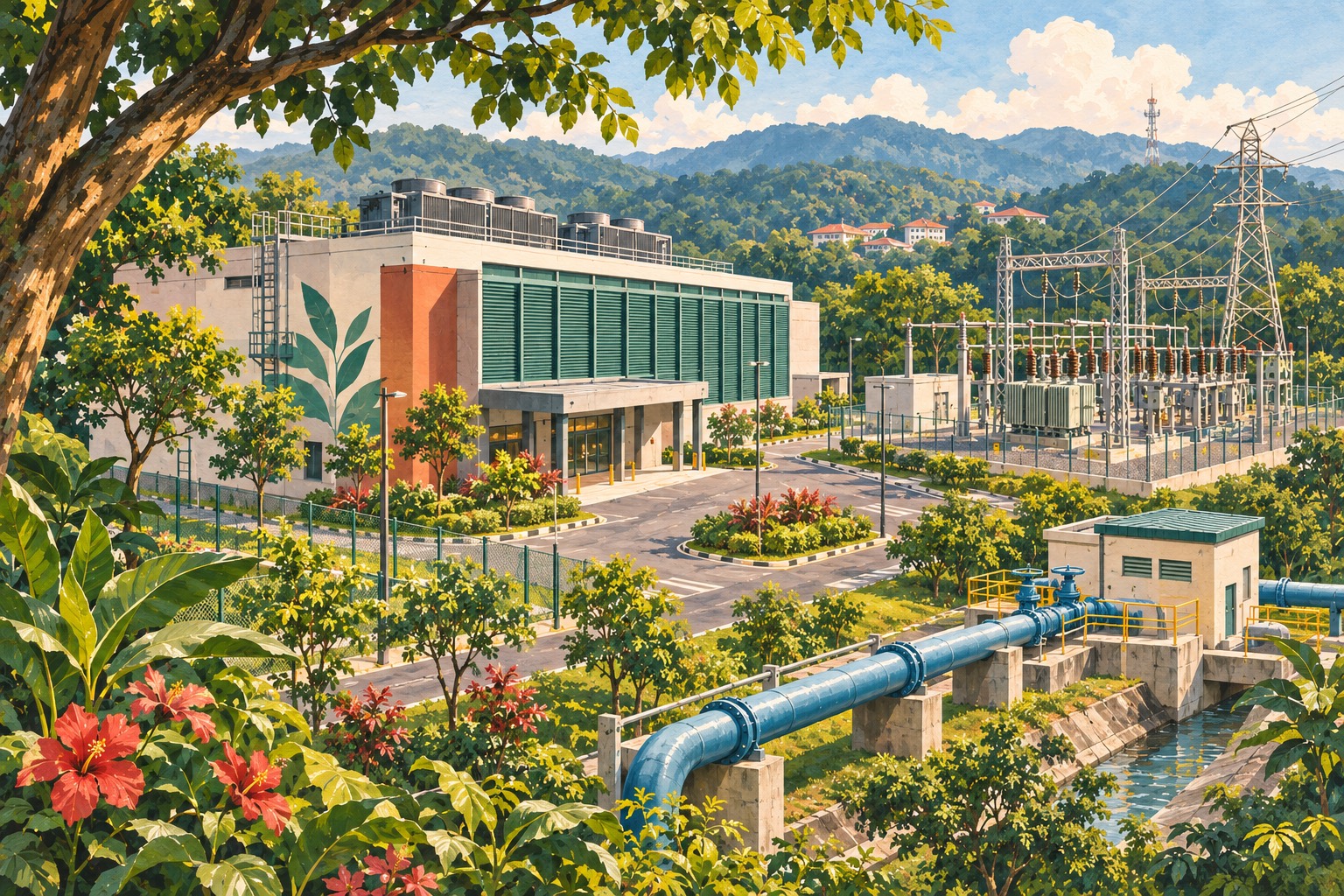
A new data centre needs more than land and fast internet. Before its servers start running, someone has to work out where the electricity and cooling water will come from, and whether the surrounding infrastructure can keep up.
That calculation is getting closer scrutiny in Malaysia. Digital Minister Gobind Singh Deo said on 15 November that the government is examining the power and water requirements of data-centre development through the Data Centre Task Force, or DCTF.
Speaking after EmpowerHER Digital 2026 in Bandar Utama, Petaling Jaya, he said supplies currently meet the sector's needs. The task is to plan for the projects coming next, rather than wait for their demand to arrive.
Count the projects before planning the pipes
RTM reported that the task force brings together the Digital Ministry, MITI, Tenaga Nasional, water-supply agencies and state governments. Gobind and MITI Minister Johari Abdul Ghani co-chair it.
The exercise covers facilities already operating, those under development and new investments expected to proceed. Their combined requirements will help officials assess applications against available infrastructure.
For a resident or small business near a proposed site, that makes the approval process relevant well beyond the project fence. The practical question is whether new demand has been considered alongside the other users of the same basic services.
Gobind's statement does not identify a current supply failure. It describes checking capacity ahead of approvals and preparing for future needs. That is the point at which a large development can be matched to its location, rather than assessed only as an investment announcement.
Malaysia already has an efficiency framework
The country is not starting with a blank page. MITI's sustainable-data-centre guidelines set out energy, water and carbon measures for eligibility under the Digital Ecosystem Acceleration Scheme, known as DESAC.
A ministry statement dated 10 December 2024 explains the policy's purpose: to use those measures as conditions for tax incentives. The framework was developed with MIDA and SIRIM and builds on existing policy.
Its three abbreviations describe different things. Power Usage Effectiveness, or PUE, concerns energy efficiency. Water Usage Effectiveness, or WUE, concerns water consumption relative to the energy used by IT equipment. Carbon Usage Effectiveness, or CUE, adds the emissions dimension.
These measures help turn a broad promise of sustainability into matters that can be assessed. They also explain why one attractive efficiency figure cannot describe every consequence of a facility.
A ratio needs a real operating context
The detailed MITI guidelines recommend a design WUE of 2.2 cubic metres per megawatt-hour or lower. They also call for monitoring and disclosure of actual WUE in annual sustainability reporting, with improvement over time.
They encourage water-efficient practices and allow reclaimed or reused water. For new sites in Peninsular Malaysia, the guidelines also say organisations should avoid areas of water stress, using the specified water-stress assessment.
That gives the discussion a geographical dimension. How efficiently a building uses water and where it obtains that water are both relevant. A design ratio alone cannot explain the condition of every local supply system.
The same distinction applies to energy: a measure of operational efficiency and the amount of new capacity required answer different questions. Planning needs to know both how the facility performs and the scale of the development proposed.
The regional guide asks for comparable measurements
ASEAN's sustainable-data-centre guide adds another useful detail: operating conditions matter when comparing efficiency numbers. Its definition of annualised PUE uses energy measured across a full year.
The guide calls for reporting once a site reaches at least 50 per cent IT utilisation and steady operations of at least 15 months. It also distinguishes tropical and temperate climate bands.
That matters for comparisons involving Malaysia. A tropical facility and a building in a cooler climate face different cooling conditions. A newly operating site with little equipment in use also differs from one carrying a mature workload.
The regional document presents indicative performance ranges for voluntary adoption or national calibration. Its value here is the discipline of asking for the conditions behind a number, rather than treating all advertised figures as directly comparable.
Less water can mean more electricity
The International Energy Agency's 2026 report, Powering Artificial Intelligence, describes a trade-off in cooling: equipment that reduces water use can require more energy, and the reverse can also apply.
It also points out that water consumption takes place beyond the data-centre building, including in power generation. Looking only at the facility's direct water use therefore leaves out part of the relationship between electricity and water.
For Malaysian planning, the implication is to examine the two systems together. Selecting a cooling approach in isolation may move a burden rather than fully explain it. This is why having utilities and water agencies involved in the same discussion is useful.
The bill depends on how costs are allocated
The IEA also cautions against a simple assumption about household electricity bills. A large customer can spread existing fixed network costs across more consumption, or require new investment whose costs are recovered from other users.
Which outcome occurs depends partly on tariff and connection arrangements. The report discusses tools such as long-term commitments and charges for reserved capacity to allocate costs and risks.
Those are international policy examples, not newly announced Malaysian charges. They show why a responsible debate should ask who pays for additional infrastructure instead of assuming either cheaper bills or an automatic household penalty.
What to watch after the announcement
The next useful evidence will be how resource assessments shape individual approvals: the capacity available, the expected demand, the water source and the performance that operators actually report.
Malaysia's existing incentive guidelines and the regional reporting approach supply concrete questions for that scrutiny. Gobind's latest assurance is that supplies are sufficient now; the task force's job is to keep new development aligned with the infrastructure needed to sustain it.
For households and businesses, success would mean growth that arrives with credible service planning. The important work happens before a new bank of servers starts drawing on the network.
Sources & further reading
Prepared with AI assistance from linked reporting. The cover is an AI-generated editorial illustration. Spotted something we should correct?