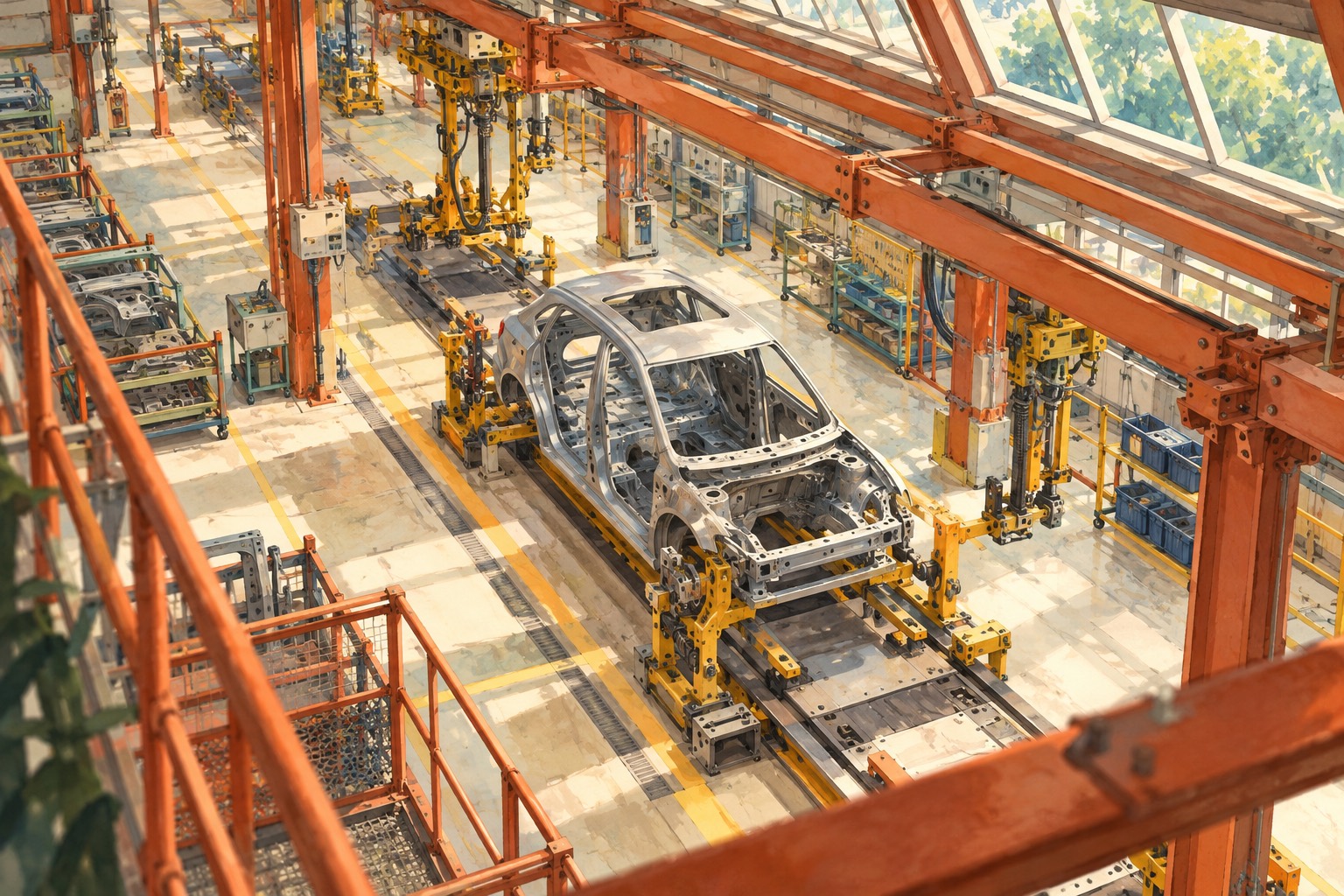
A new car rolling out of a Malaysian factory is the easy photograph. The harder business question is how much of the work behind it stays here.
That is the useful angle on EP Manufacturing Berhad’s latest update from Pegoh, Melaka. Reporting on 2 November describes a faster assembly line, additional inspection facilities and progress towards a RM200 million paint shop. Together, they point towards a broader manufacturing operation, rather than simply more places to bolt cars together.
The distinction matters to local suppliers, people considering manufacturing careers and buyers who hear that a vehicle is locally assembled. Those groups have different interests. None is well served by turning a factory’s theoretical capacity into a promise of jobs, sales or cheaper cars.
Capacity is room to produce, not a sales receipt
Chairman Hamidon Abdullah said the operation’s annual assembly capacity now exceeds 30,000 vehicles on a single extended shift, according to Paul Tan’s report. One line’s reported pace increased from four to ten vehicles an hour.
Those are capability measures. They do not establish that customers have ordered every available slot or that the plant will operate at that rate throughout an entire year.
It is tempting to divide any production figure by the newest capacity announcement and call the result utilisation. That comparison needs matching periods and definitions. A cumulative total covering several years cannot, by itself, show how full a factory will be next month.
For a supplier considering an investment, the more useful questions concern a confirmed programme, the parts required and the delivery schedule. A larger factory can create an opening for that conversation. It cannot replace a purchase order.
Localisation becomes clearer when parts are named
A separate report on the same day describes local content in the Wey G9 HEV and Ora 5 HEV programmes. Listed components include front frame modules, rear axles, instrument panels and wiring harnesses, with further items identified for the Wey.
The company also reported more than 10,000 GWM vehicles assembled locally since October 2024 and over 1,100 Wey G9s exported to Thailand and Indonesia. These are reported cumulative milestones, rather than audited figures supplied with this article or forecasts for the coming year.
Named components make the discussion more concrete than an unqualified claim that a car is Malaysian-made. Even so, a list is not a complete percentage breakdown of local value. It does not tell us the domestic share of every part, process or material in a vehicle.
For readers, that is a good distinction to keep. Ask what is manufactured or supplied locally, rather than assuming that assembly location answers every question about the supply chain.
The paint shop is still a future milestone
The latest account places the start of the new paint facility’s production at the end of August 2027. That remains a target, not an operating result already achieved in November 2026.
EPMB’s June announcement had set out the broader plan: bring painting alongside parts production, assembly, quality assurance, testing and export support within its Pegoh campus. It described the move as part of becoming a more integrated manufacturing partner.
The practical business logic is understandable. A customer seeking several manufacturing services may find a combined operation attractive. Whether that becomes a commercial advantage depends on what the completed operation can deliver, at an acceptable cost and quality, for actual programmes.
There is also a reporting detail worth handling carefully. Earlier announcements and the latest update use different capacity figures for the paint development. The newest report refers to 50,000 vehicle sets annually. These should not be silently added to assembly capacity or treated as extra finished-car sales.
Automation brings a different set of questions
Invest Melaka’s June account described robotics, water-based paint systems and a dry spray approach. It presented a potential waste reduction as an aim of the planned process, rather than a measured result from an operating facility.
That is an encouraging direction to examine. It is still too early to describe the environmental savings as achieved or attach them to every vehicle leaving the existing factory.
Likewise, the presence of automation does not, without a workforce plan, tell a reader how many jobs will be created, displaced or changed. A projected employment number is different from vacancies advertised today, and neither establishes the salaries attached to those roles.
People interested in work should therefore look for specific positions and requirements when openings are published. For a student choosing a course, the announcement is a reason to investigate the industry’s actual roles, not a guarantee that a particular qualification will secure employment there.
Why the policy backdrop matters
In a March statement reproduced by Paul Tan, MITI said Malaysia wanted foreign automotive investment to extend across the value chain, including components, research, logistics and after-sales. That explains why localisation attracts attention beyond the opening ceremony.
The question is not merely whether an overseas badge appears on a locally assembled car. It is what lasting capability develops around the programme and which activities Malaysian businesses can supply competitively.
The ministry’s general policy direction should not be mistaken for a certificate that this particular expansion has fulfilled every objective. Those outcomes need to be assessed through the work actually completed and the commercial relationships that follow.
What a car buyer can conclude today
For buyers, factory investment and product value are related questions, but they are not interchangeable. An expansion announcement supplies no automatic discount, warranty improvement or delivery date for the model on your shopping list.
Check the current Malaysian vehicle specification, written price and support terms when making a purchase. For businesses near Pegoh, watch for confirmed supplier opportunities rather than treating a headline production ceiling as guaranteed demand.
The next meaningful milestones are completion, commissioning and sustained production—not another multiplication of capacity numbers. Melaka’s wider car-making ambition is worth following. Its value will be clearest when the additional work moves from plans into parts, processes and orders that local people can point to.
Sources & further reading
Prepared with AI assistance from linked reporting. The cover is an AI-generated editorial illustration. Spotted something we should correct?