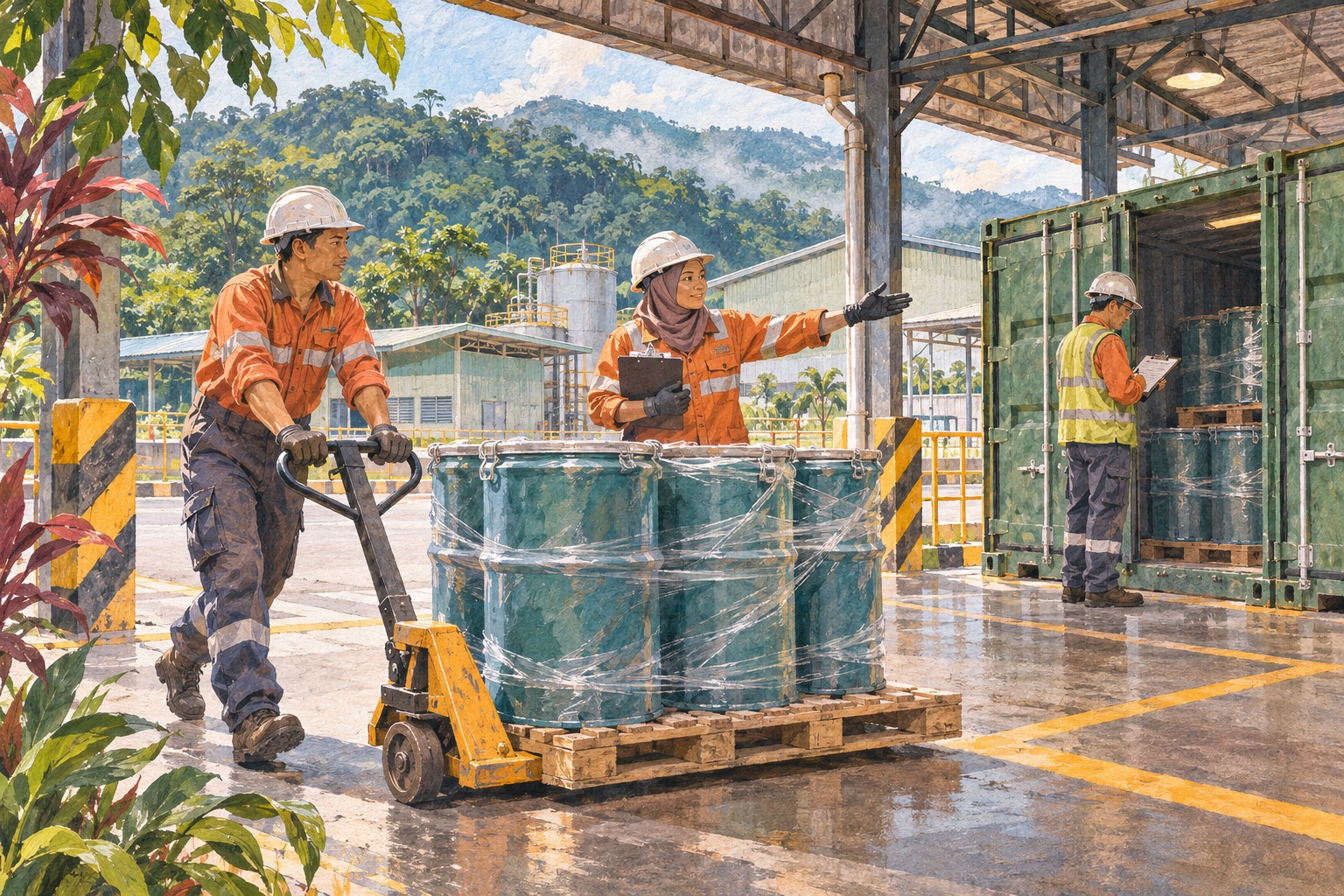
Sarawak is moving closer to controlling how scheduled waste is regulated within the state, but factories and waste operators should not treat Friday’s Cabinet decision as an overnight change of law. Royal consent and formal legal steps still have to come first.
The Cabinet agreed to a memorandum proposing amendments to the Borneo States (Legislative Powers) Order. The change would confer the relevant federal legislative power on Sarawak under Article 95C of the Federal Constitution, as part of the Malaysia Agreement 1963 agenda.
Government spokesman Fahmi Fadzil said the proposal had received clearance from the Attorney-General’s Chambers and would next be submitted for royal consent from Sultan Ibrahim, King of Malaysia.
Scheduled waste is not ordinary household rubbish
In environmental regulation, scheduled waste refers to categories of hazardous or controlled waste listed under law. It can include waste oils, solvents, contaminated containers, clinical material and industrial residues that require specific storage, transport and treatment.
The practical consequences therefore reach beyond municipal bin collection. Manufacturers, laboratories, hospitals, workshops, waste transporters and treatment facilities may all have compliance duties depending on what they generate or handle.
Friday’s announcement did not publish new Sarawak forms, licence conditions or enforcement dates. Existing operators should continue following the rules and approvals currently applicable to them until the competent authorities announce the transition.
Why the order must change
Fahmi said the amendment is a necessary step before application of the federal Environmental Quality Act 1974 is suspended in Sarawak for scheduled-waste management. That sequence matters: power must be conferred in an orderly legal process before the state assumes responsibility.
The government says the handover is intended to prevent overlapping jurisdiction between federal and Sarawak authorities. For a regulated business, overlap can mean uncertainty about which agency approves a facility, receives a report, inspects a shipment or takes enforcement action.
A clear transition should identify the cut-off date for pending applications, whether existing federal licences remain valid, and where historical records will be held. Without those details, a company could comply with the wrong process despite trying to follow the law.
What Sarawak gains — and what it must build
Greater state control can allow regulation to be designed around Sarawak’s geography and industrial profile. Long distances, remote facilities, oil-and-gas activity, plantations, manufacturing and the movement of waste between divisions create operating realities that differ from a compact urban state.
Control also brings responsibility. The state will need trained inspectors, laboratories, digital records, licensing capacity and credible enforcement. It must be able to trace waste from the generator to an approved transporter and final treatment or disposal site.
If the system is weaker at any point, hazardous material can be misdeclared, stored too long or dumped illegally. If it becomes unnecessarily complicated, compliant businesses face delays while irresponsible operators gain an advantage.
The best measure of devolution is therefore not how many powers move on paper, but whether the new authority can respond faster, publish clearer data and reduce environmental risk.
Businesses need a transition map
Companies operating in Sarawak should watch for official notices from the state government and the Natural Resources and Environmental Sustainability Ministry. A proper transition guide should answer several basic questions.
Which agency becomes the regulator on the effective date? Do existing licences transfer automatically? Which manifest or tracking system should a transporter use? How will waste crossing from Sarawak to another jurisdiction be handled? Where should an incident be reported?
Contractors also need time to update agreements. A factory may outsource collection, but it cannot assume that signing a contract removes every legal duty. It should verify that its transporter and treatment facility remain authorised under the system in force.
Smaller businesses need guidance written for non-specialists. A workshop holding used oil or contaminated filters may not have an environmental department, yet mishandling those materials can still harm workers, waterways and nearby communities.
This is the first phase, not the final settlement
Fahmi said environmental powers would move to Sabah and Sarawak in phases, beginning with scheduled waste. Friday’s decision is therefore both a specific regulatory change and a test of how MA63 implementation works in practice.
The federal and state governments will need to coordinate during the handover. Data, pending investigations and technical expertise cannot simply stop at a jurisdictional line. Emergency response is another area where clear cooperation matters, especially if a spill affects a river, road or community beyond one authority’s immediate control.
Public reporting can build confidence. Sarawak could publish the number and type of licensed facilities, inspection results, enforcement actions and trends in waste generation without disclosing legitimate commercial secrets. Communities living near treatment or disposal sites should know how complaints and monitoring will work.
The Cabinet approval is a meaningful constitutional step, but it is not yet a licence for anyone to change procedures. The handover succeeds when every operator knows who is in charge, every shipment remains traceable, and Sarawakians receive stronger protection rather than a new layer of uncertainty.
The cost question cannot be left vague
A new regulatory system has operating costs. Licence fees, waste-tracking requirements and treatment capacity can affect manufacturers and smaller workshops, while weak enforcement transfers the real cost to communities and the environment. Any revised charges should be announced early and tied to a clear service, rather than appearing after companies have signed transport or disposal contracts.
Sarawak will also need enough approved treatment capacity. Sending hazardous waste over long distances raises transport cost and road risk; allowing unsuitable local disposal creates a larger danger. Planning data should show which waste streams can be handled in-state and which require movement elsewhere under controlled conditions.
For residents, the transition should include one public complaint route and clear response times. A photograph of suspected dumping is useful only when the responsible agency can inspect the site, trace the material and explain what action followed.
Sources & further reading
Prepared with AI assistance from linked reporting. The cover is an AI-generated editorial illustration. Spotted something we should correct?