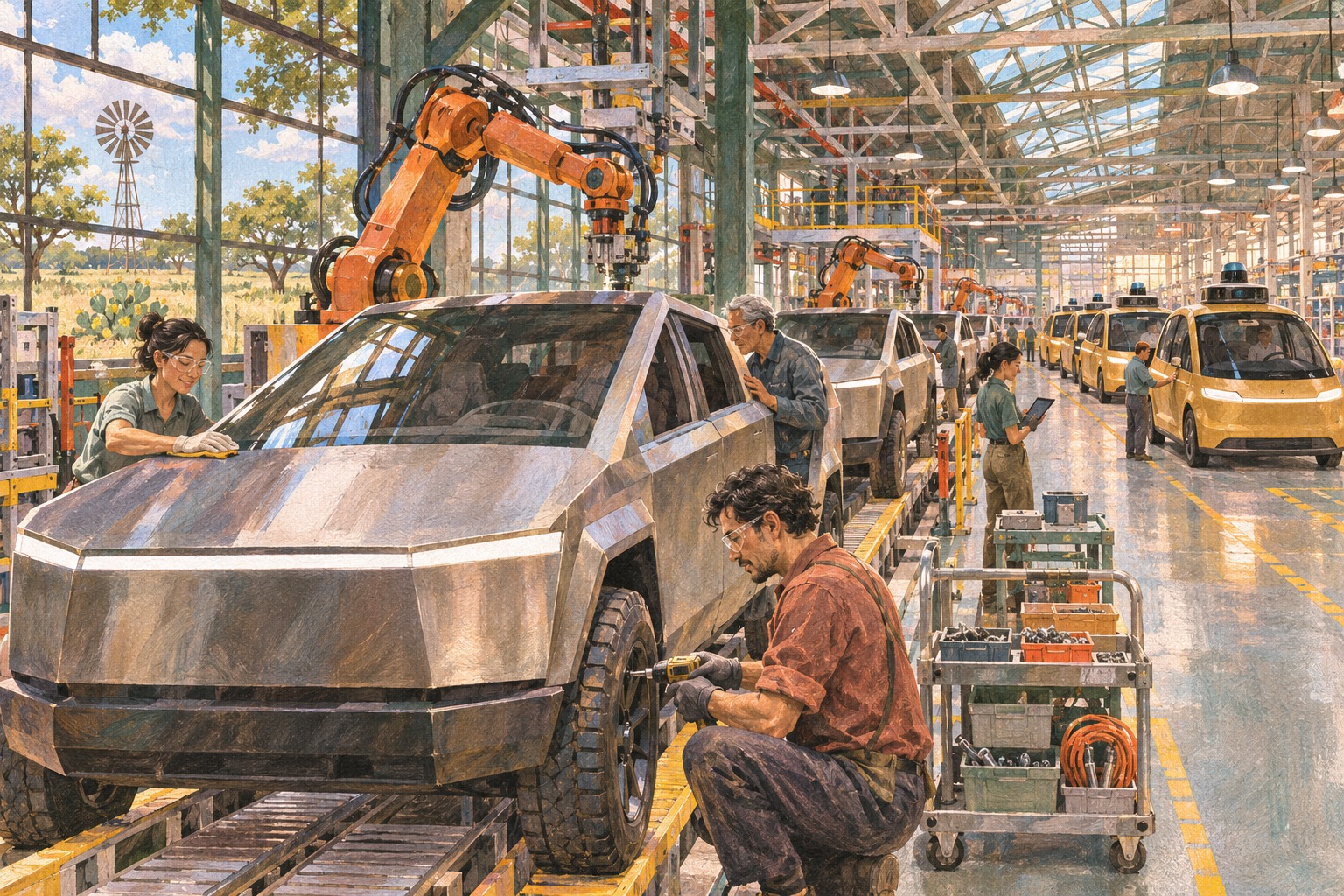
Tesla plans to wind down Cybertruck production at Gigafactory Texas around the middle of 2027 and use the space to build more Cybercabs. Elon Musk confirmed the shift on 6 November, then said on 9 November that some customers holding Cybertruck deposits would be offered refunds as the company works through remaining orders.
The decision closes the production chapter on one of the most recognisable vehicles of the past decade. The stainless-steel pickup was unveiled in 2019, reached customers in 2023 and became famous for both its angular body and the “armour glass” demonstration that ended with shattered windows.
Why Tesla is choosing the robotaxi
Musk said the opportunity cost of Cybertruck’s complexity is outweighed by the value of additional Cybercab production. In practical terms, keeping a specialised pickup line operating uses factory floor space, equipment, workers and suppliers that Tesla now wants focused on its autonomous two-seat vehicle.
The Cybercab sits at the centre of Tesla’s attempt to build a transport-service business around autonomous vehicles. Its third-quarter update said Cybercab had joined the Austin fleet and that the company had accumulated almost two million unsupervised miles. Scaling that programme, however, still depends on production, regulation, safety performance and public acceptance.
Cybertruck owners will continue to need parts, software support and service after production ends. Tesla has not detailed in the reports how long replacement body panels and model-specific components will remain available. Buyers with pending orders should check their Tesla account for updated delivery or refund instructions rather than relying on screenshots from other markets.
A distant story for Malaysian roads
The Cybertruck has never been a mainstream Malaysian model. Its size, left-hand-drive origins and limited official availability kept it more visible online than on local roads. For Malaysian EV watchers, the larger signal is Tesla’s strategic pivot: factory capacity is moving from a privately owned novelty pickup to a vehicle designed for shared autonomous trips.
That does not mean Cybercab service is coming to Malaysia. Tesla has not announced a Malaysian deployment timetable, and local rules, mapping, insurance and road conditions would all need to be addressed. The immediate change happens in Texas, where the line is expected to wind down around June or July 2027.
Cybertruck proved that an outrageous shape could dominate conversation. Cybercab now has to prove something harder: that the factory space freed by ending the truck can produce a reliable transport service people are willing and legally allowed to use.
Sources & further reading
Prepared with AI assistance from linked reporting. The cover is an AI-generated editorial illustration. Spotted something we should correct?