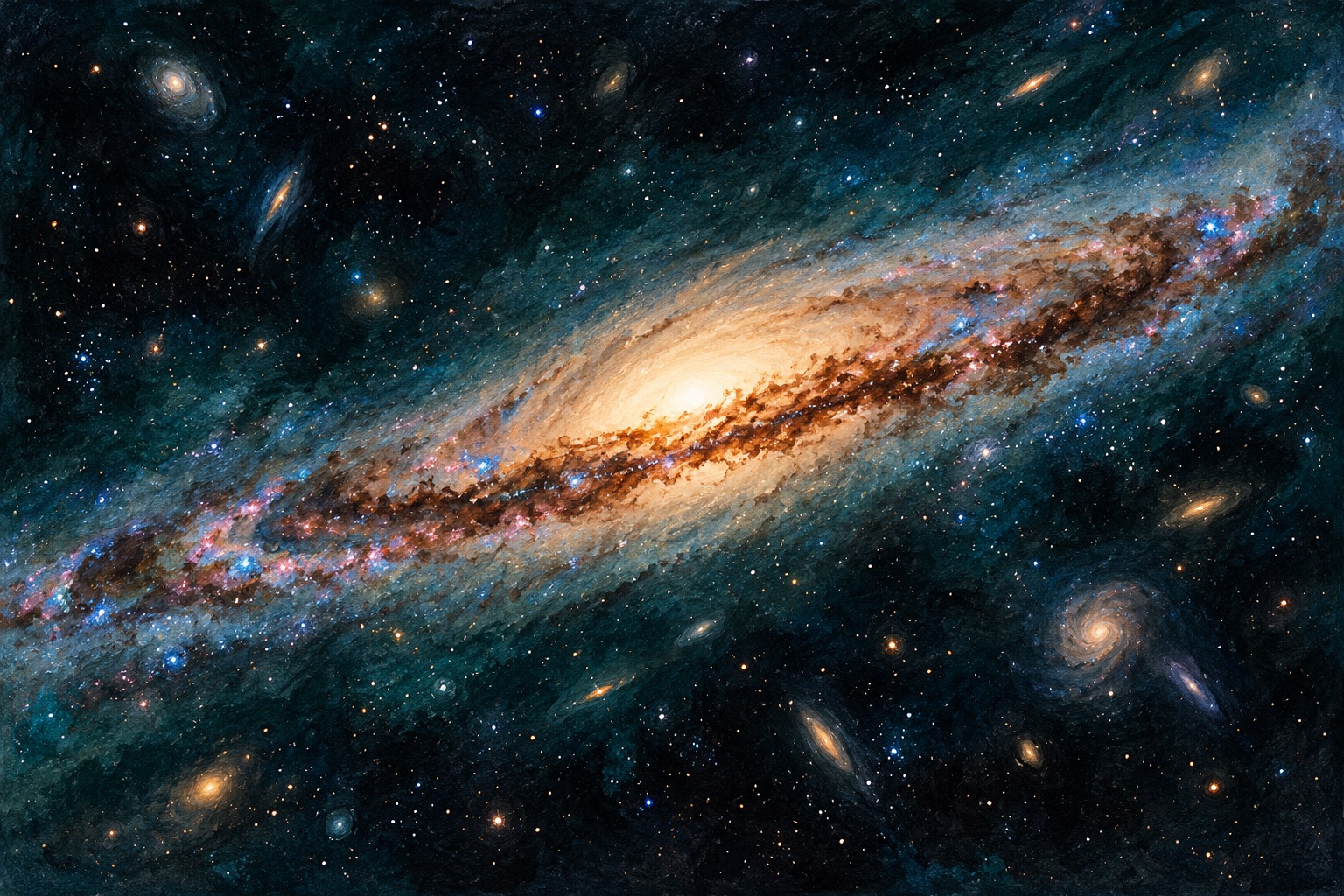
It looks almost like a glowing scratch across the sky. That narrow strip in Hubble’s newly featured image is actually NGC 1827, an entire spiral galaxy seen from the side, about 37 million light-years from Earth.
NASA published the view on 16 October. Instead of the familiar pinwheel shape, we get a bright central swelling, a long dusty disk and little flashes of blue. The viewing angle hides some features and makes others much easier to spot.
There is also a bright, four-pointed star that seems determined to steal the scene. It is nowhere near the galaxy. Once you know why it has those spikes, the picture becomes a small lesson in how telescopes turn light into evidence.
A spiral does not always look like a spiral
Think of a plate on a shelf. Seen from above, its round shape is obvious. Viewed along its edge, it becomes a thin line. The object has not changed; your position has.
NASA’s guide to galaxy types describes spiral galaxies as rotating, disk-shaped systems with central concentrations of stars and spiral arms. Our Milky Way belongs to this broad family. Some external galaxies show their arms clearly, while others present their edges towards us.
NGC 1827 falls into the latter group. NASA identifies it as an intermediate spiral in the constellation Columba, the Dove. The current view does not give us a face-on map of its arms, so the absence of an obvious pinwheel in the picture is no reason to assume the galaxy lacks them.
Orientation is one of the first things to consider when looking at space images. Two galaxies can appear very different partly because we are seeing them from different directions, rather than because every visible difference reflects a completely different kind of object.
The brown band is part of the story
Look along the disk and you will find rusty-brown dust lanes cutting across the glow. Dust changes which parts of a galaxy are easy to see. In this image, those dark structures help give the thin disk its layered appearance.
The blue patches provide a different clue. NASA says these regions likely mark places where stars are forming. That wording matters: the colour is evidence researchers interpret, rather than a label stamped onto each individual point in the photograph.
In NASA’s broader account of spiral galaxies, young stars form in gas-rich arms, while older stars occur across the disk, bulge and surrounding halo. A galaxy therefore contains several overlapping populations, rather than one uniform sheet of identical stars.
That makes the picture more interesting than a simple bright-versus-dark comparison. The central glow, dust lanes and blue regions tell us about different structures within one system. The sideways view brings their relationship into sharper visual focus, even as it conceals the familiar outline of the arms.
That spiky star is a telescope effect
Near the galaxy’s central bulge, a bright foreground star shows four sharp spikes. It can look like a decorative star someone has drawn over the image. The spikes are produced by the telescope’s optics.
NASA explains that light bends around the structures supporting Hubble’s secondary mirror. This diffraction creates the familiar cross-like pattern around bright stars. It is not a set of four physical arms sticking out of the star.
The star is in the foreground, while NGC 1827 lies much farther away. Other small galaxies appear behind it. All these objects share a flat image on your screen, but they occupy very different depths in space.
That is an easy trap for the eye. A bright object placed next to a galaxy can seem to belong to it. Here, knowing which object is foreground and which is distant changes the scene from a collection of pretty lights into a view through several cosmic layers.
Hubble was looking beyond one photogenic disk
The observation belongs to a survey of satellite galaxies around systems resembling our Milky Way. NASA describes a programme targeting 260 satellites around 22 larger host galaxies.
At the point described in the release, 111 targets had been observed. The remaining 149 were allocated one Hubble orbit each. That is a useful glimpse of how a striking public image fits into a much larger observing plan.
Small galaxies are especially valuable for testing ideas about the universe. NASA says these low-mass systems let researchers examine how well cosmological models work on smaller scales, then refine those models using observations.
The work is therefore about comparison across many objects. One attractive galaxy picture does not, by itself, settle a theory of the universe. Building a sample lets astronomers look for patterns, differences and cases that a model struggles to explain.
The camera has survived its own drama
Hubble captured the view using its Advanced Camera for Surveys, or ACS. Astronauts installed the instrument in 2002 during Servicing Mission 3B, adding a powerful wide-field imaging tool to the observatory.
It has not been an uninterrupted success story. An electronics failure in January 2007 stopped the two most-used science channels from working. During Hubble’s final servicing mission, astronauts repaired the Wide Field Channel. The High Resolution Channel could not be restored.
The repaired channel had accounted for 70% of ACS science before the failure, according to NASA’s instrument history. Its recovery helped preserve a substantial part of Hubble’s imaging capability.
ACS uses detectors and selectable filters to record particular ranges of light. Its channels serve different tasks, from broad views to ultraviolet observations. Those choices help astronomers study objects whose useful signals do not all arrive in the same part of the spectrum.
So the next time a space picture stops your scroll, try three questions before moving on. Which direction are we viewing the object from? Which features belong to the object, and which come from the telescope? And what larger investigation produced the observation?
With NGC 1827, the answers take you from a narrow streak of light to dust, star formation, small-galaxy research and a camera astronauts brought back into service. Quite a lot is hiding in that sideways glance.
Sources & further reading
Prepared with AI assistance from linked reporting. The cover is an AI-generated editorial illustration. Spotted something we should correct?