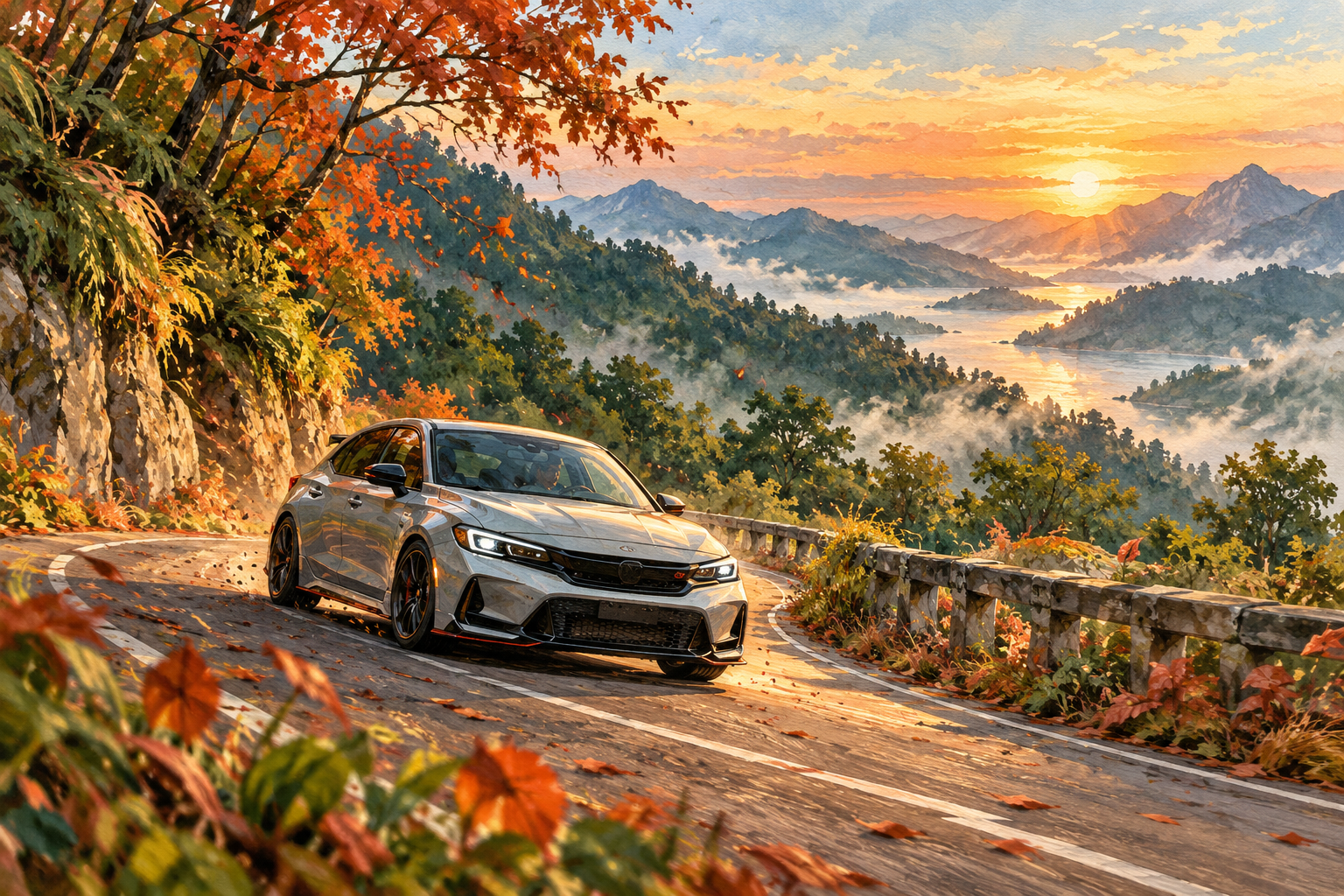
Honda has given the Civic Type R a fresh face for 2027, but the interesting part is what it did not replace. The turbo engine remains, the six-speed manual remains, and the car still asks the driver to do the shifting. The changes are concentrated in cooling, the way it settles into corners, the feel of its brakes and the speed of its automatic rev matching. For anyone who cares more about the next bend than the next screen, that is a more revealing update than a new badge would have been.
The refreshed Type R was announced for the US on 1 October and is due at American dealers later in the month. Honda gives it a manufacturer's suggested retail price of US$48,695, excluding destination and other charges. That is a US-market figure, not a Malaysian on-the-road price. Honda Malaysia has not announced a local launch, price or specification for this update, so the familiar temptation to convert dollars directly to ringgit will not tell buyers what they might actually pay here.
Where the nose does more work
At first glance, the front bumper looks more aggressive. Honda says the larger grille opening is there to move air more effectively through the car, improving engine cooling. A deeper front splitter is intended to increase downforce. The company also says it has reduced turbulence around the intake so airflow reaches the cooling system more efficiently. Those are engineering claims for the new design; they do not by themselves give us independent lap times or road-test results.
Why should a road-car driver care about cooling? A performance car can feel strong on a short burst yet struggle to maintain that performance when pushed repeatedly. Better airflow matters most when the engine and brakes are working hard. Honda frames the front-end work around sustained track driving, which fits a Type R's role even if most owners will spend far more time in ordinary traffic. Until independent testers drive it, the size of the benefit remains a question; the mechanism is at least specific.
The 2.0-litre turbocharged four-cylinder engine continues to make 315 horsepower in the US car. The six-speed manual stays the only transmission. Honda's release highlights a faster response from the Rev Match system when downshifting, which should make a lower gear feel more natural when entering a corner. Drivers who prefer to match revs themselves still have the basic manual layout they came for.
Honda has also adjusted the suspension damping in +R mode. It says the change helps the tyres follow the road and reduces bouncing and harsh impacts during cornering. This is the kind of calibration that is difficult to judge from a specification table: it may improve confidence on a circuit, but the trade-off in comfort on a rough Malaysian road would need a real drive. The company has not claimed a new engine output or a complete platform overhaul, so calling this an all-new Type R would oversell it.
Brakes and small tactile details
The brake pedal receives a yoke spring intended to remove some play in the linkage and give a more direct feel. That sounds minor beside horsepower, but braking is repeated at every junction and every bend. A pedal that lets the driver place pressure more accurately can change confidence even when the stopping hardware is otherwise familiar. Again, the claim needs hands-on confirmation; Honda has explained what it changed, not published a measured improvement in braking distance.
Inside, the driver's world gains heated front seats, an Ultrasuede upper dashboard and door treatment, darker trim, two USB-C ports and an auto-dimming mirror. New perforations in the red sport-seat fabric are meant to improve comfort and grip. A fresh Meteorite Gray Metallic joins the colour choices. These are everyday refinements around a car still sold on its driving character. The three-level seat heating will be a bigger selling point in a cold US winter than in Kuala Lumpur, while the less reflective dashboard might be useful anywhere in bright daylight.
Google built-in also arrives as standard in the announced US car, with Maps, Play and Gemini integrated alongside Alexa. The point is not that Type R has suddenly become a tech-first car; it is that navigation and voice control now sit in the same cabin as one of the few performance cars still offered only with a manual. Buyers should check the eventual local infotainment specification rather than assuming every US service and feature will transfer unchanged to Malaysia.
Safety equipment gets a quieter update. Honda says its sensing system now has improved recognition of motorcycles and bicycles for collision mitigation, smoother cruise-control responses and lane keeping that better handles road camber. Post-Collision Braking is newly standard to help reduce the chance of a second impact after an initial crash. Driver-assistance systems have limits and are not substitutes for attention, but these changes broaden the car's everyday brief beyond lap-time talk.
The price question still belongs to Malaysia
The US launch coincides with the Type R's 30th global anniversary, counting from its 1997 Japanese debut. Honda's official US release calls this its sixth generation. That heritage explains why the manual transmission matters to the model's identity, but nostalgia is not enough to settle a buying decision. Local price, allocation, warranty and equipment would be the numbers Malaysian buyers need next.
For now, the refresh looks focused: more air through the front, different damper and brake feel, quicker downshift assistance, and a cabin made easier to live with. The headline horsepower is unchanged. If the update arrives in Malaysia, the best test will be an ordinary drive as well as a fast one, because a Type R earns its reputation in how precisely it responds each time the driver steers, brakes and changes gear.
Sources & further reading
Prepared with AI assistance from linked reporting. The cover is an AI-generated editorial illustration. Spotted something we should correct?