A flat sheet of metal does not look much like a building. Fold it into the right shape, connect it to other pieces, and the result can become a surprisingly rigid shell.
MIT researchers have developed a modular construction approach built around that idea. Their 27 October report points to possible uses from architectural components to emergency shelters. There is already a room-scale demonstration hanging in a Boston library, although a sculpture and a shelter ready for a flood response are very different milestones.
For Malaysian readers, the appeal is easy to understand: something that travels flat and becomes a useful structure on arrival could change transport and assembly. The part still to be established is how such a system performs when it has to protect people, rather than demonstrate an engineering principle.
Start with the shape of the pieces
In the new work, individual cells are fabricated from sheets, folded and connected into a larger framework. The design aims to create stiffness through geometry and assembly, rather than simply adding more material everywhere.
MIT says the shell can carry loads without interior support columns. Its reported comparisons are with some other origami-based techniques, not every conventional building system. That makes the reference point important: a promising result within a research comparison is not evidence that all ordinary construction should be replaced.
The team identifies larger architectural testing as a next step. Readers should therefore treat the emergency-shelter application as a direction for development, rather than an announcement that a new relief housing product is available in Malaysia.
You can already see the idea in a public space
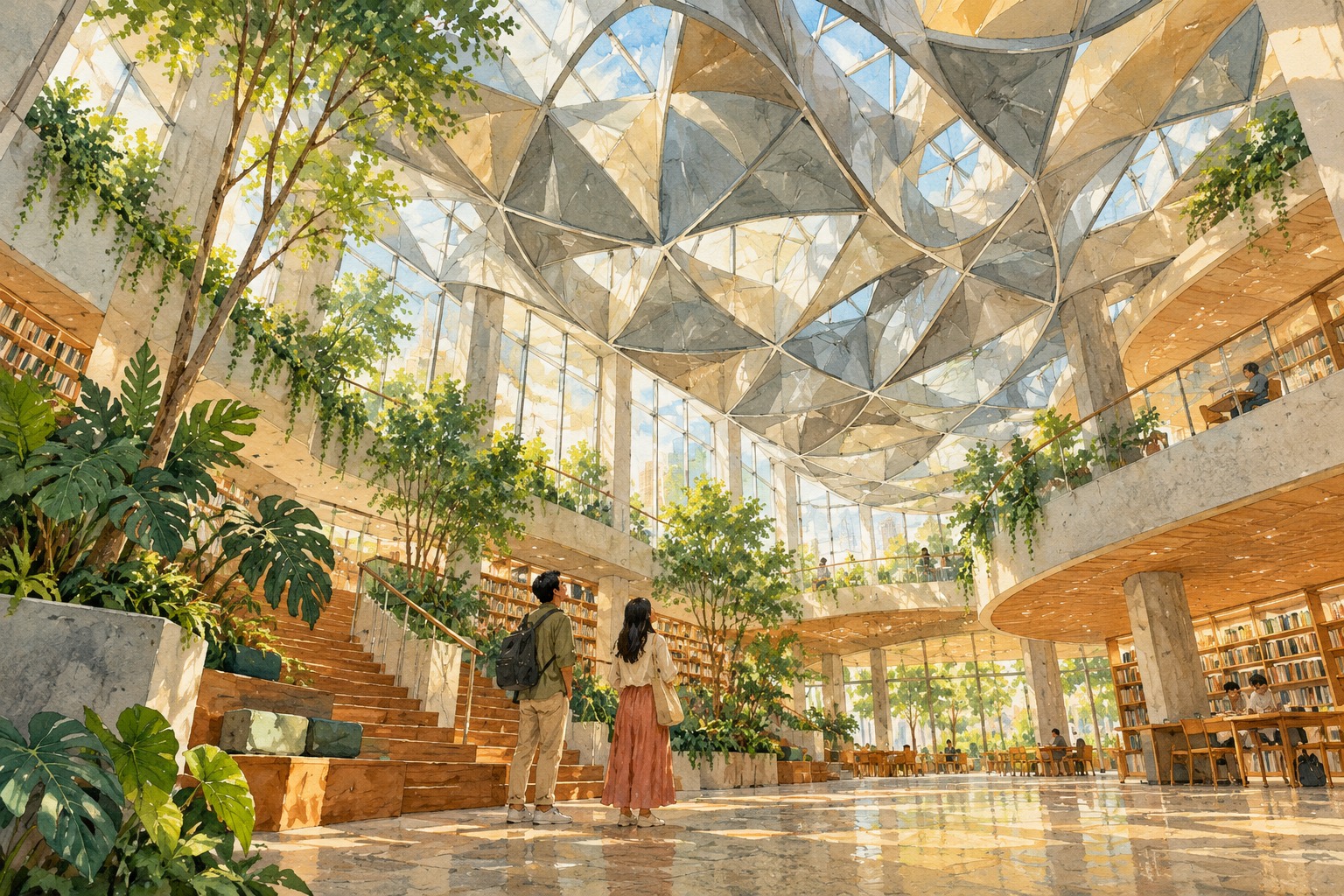
Boston Public Library describes Lexicon as a structural shell assembled from individually folded cells forming an interlocking framework. Its listing places the installation in Deferrari Hall at the Central Library in Copley Square.
The library explains the visual relationship to its surroundings: the light, curved form sits against the heavier architecture of the Boylston Street building. The work also refers to the tiled ceilings associated with Rafael Guastavino in the library's McKim Building.
Those details make the demonstration more useful than a tiny object photographed on a lab bench. It gives visitors a way to judge the scale and spatial effect of the construction idea. It does not, by itself, test the duties of an occupied building.
The project also makes fabrication visible
The City of Boston's account describes the installation as a collaboration involving MIT's Center for Bits and Atoms, the library and the Mayor's Office of Arts and Culture. It links the work to custom design tools and computerized cutting of aluminium sheets.
That connects design with the way components are actually made. A beautiful shape is only part of the job; people also need parts they can fabricate and fit together. The city presents the installation as both public art and a demonstration of materials research.
For students considering engineering or design, that is an interesting overlap. The work sits between computation, fabrication and architecture, while the finished object is accessible to people who would never open a technical journal.
Paper-folding ideas have a longer engineering history
A separate MIT project reported in 2023 used kirigami, combining cutting and folding, to create lightweight metal lattices with adjustable mechanical properties. That earlier research addressed a practical difficulty: making strong cellular structures at larger scales.
Its explanation uses a sandwich-like arrangement, with a lattice core between outer panels. Changing the folding pattern created flatter surfaces that could make attachment easier. The lesson is that the connections and manufacturing steps matter alongside the shape itself.
This was earlier research, not a new product released this week. It helps explain why engineers keep returning to folding: the attraction is a route to useful geometry that can be manufactured, rather than decorative resemblance to a paper crane.
Building from small parts is another strand of the story
MIT's 2013 work explored assembling larger structures from small interlocking composite components. That is a separate material and construction approach, but it shares the question of how modest pieces can produce something much larger and mechanically useful.
Thinking in components changes what designers must consider. Alongside the overall form, there are joints, repeated operations and the relationship between one piece and its neighbours. The attraction is not simply that the parts are small; it is that a system of connections can create a useful whole.
The new folded-cell work belongs in that wider conversation. It should still be judged on its own tests, materials and intended uses rather than inheriting every benefit claimed for other modular systems.
A shelter has to do more than stand up
The Sphere Handbook treats shelter and settlement as part of humanitarian response alongside water, sanitation, food and health. That broader frame is a helpful check on excitement about any new building technique.
A structure intended for displaced families has to fit a response designed around people. Space, safety, access to services and the suitability of the location cannot be answered by a stiffness comparison alone. These are questions for deployment planning and testing, not details that can be assumed from an attractive prototype.
That is why a potential shelter application is worth following without calling it a ready-made answer to a disaster. Transport and assembly are important, but they form only part of what makes temporary accommodation useful.
Malaysia already has a response system it would need to fit
NADMA's public explanation describes a temporary evacuation centre, or PPS, as a building or area declared by the district disaster management committee's chair for accommodating affected people. Examples include schools, halls, community buildings and mosques.
Any future construction technology would therefore need to serve an organised response, rather than merely arrive as an interesting object. Whether it supplements existing centres, supports another type of accommodation or proves unsuitable would require decisions based on local needs and evidence.
For now, there is no verified Malaysian rollout or local price to offer readers. The useful development to watch next is a larger tested structure, with clear evidence about what it can safely do beyond the library atrium.
Sources & further reading
Prepared with AI assistance from linked reporting. The cover is an AI-generated editorial illustration. Spotted something we should correct?