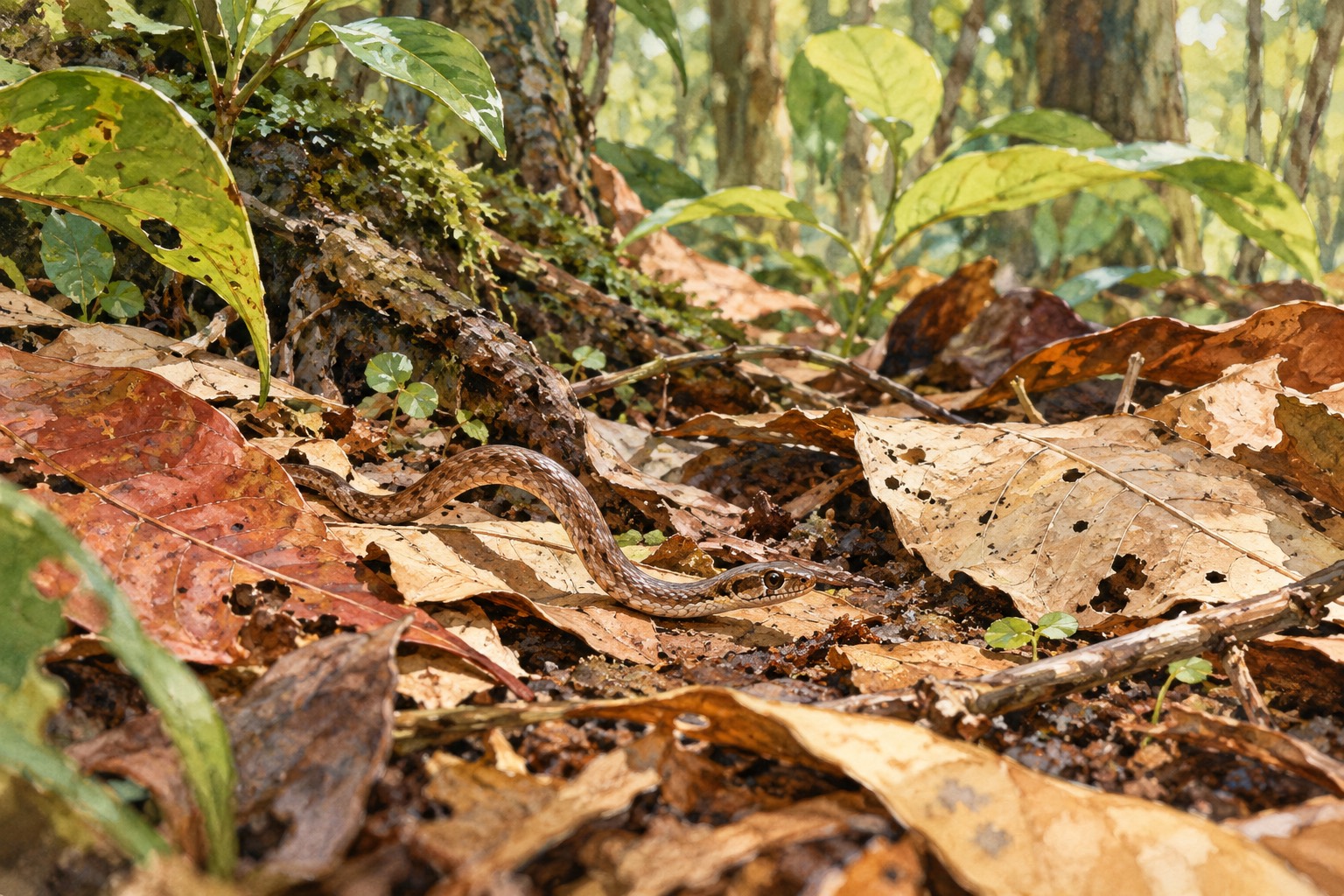
A snake escaping trouble might seem unlikely to need a rolling technique. Yet dwarf reedsnakes can do exactly that, sending much of the body around while keeping the head pointed where they are going.
ScienceDaily highlighted the research on 24 October. The underlying study appeared in Current Biology on 19 October, and Toho University has published an explanation of the movement. This is fresh coverage of that study, rather than a claim that rolling snakes were discovered today.
Researchers filmed snakes from several angles to work out how the trick happens. Instead of simply rotating the whole animal like a rigid wheel, the snakes coordinate different parts of their bodies.
A moving body, a steadier head
An arched section swings down past the side of the head towards the ground. The side touching the ground and the direction of the movement alternate as the snake continues travelling.
The result is a useful separation of jobs: much of the body provides the dramatic motion, while the head remains comparatively stable. Toho’s account says the snakes could travel along a track only 20 centimetres wide despite their speed.
During rolling, the researchers measured peak forward speeds of 1.72 to 3.69 metres per second, about four times the peak speed recorded for ordinary lateral undulation. That comparison belongs to the movements measured in the study. It should not be turned into a claim that every snake always moves four times faster when disturbed.
There is a Malaysian research connection
The authors include Mohamad Yazid Hossman and Clement Het Kaliang, alongside Yosuke Kojima, Ibuki Fukuyama and Kanto Nishikawa. Toho identifies the Malaysian contributors with Sarawak’s forestry and conservation institutions.
For readers used to seeing snakes discussed only as a danger, the study offers another reason to pay attention from a safe distance: animals can possess movement skills that their shape does not immediately suggest.
It is a remarkable piece of coordination, and the researchers’ video is a better place to watch it than trying to provoke a wild snake into performing. The small, steady head is the part worth following while the rest of the body does the acrobatics.
Sources & further reading
Prepared with AI assistance from linked reporting. The cover is an AI-generated editorial illustration. Spotted something we should correct?