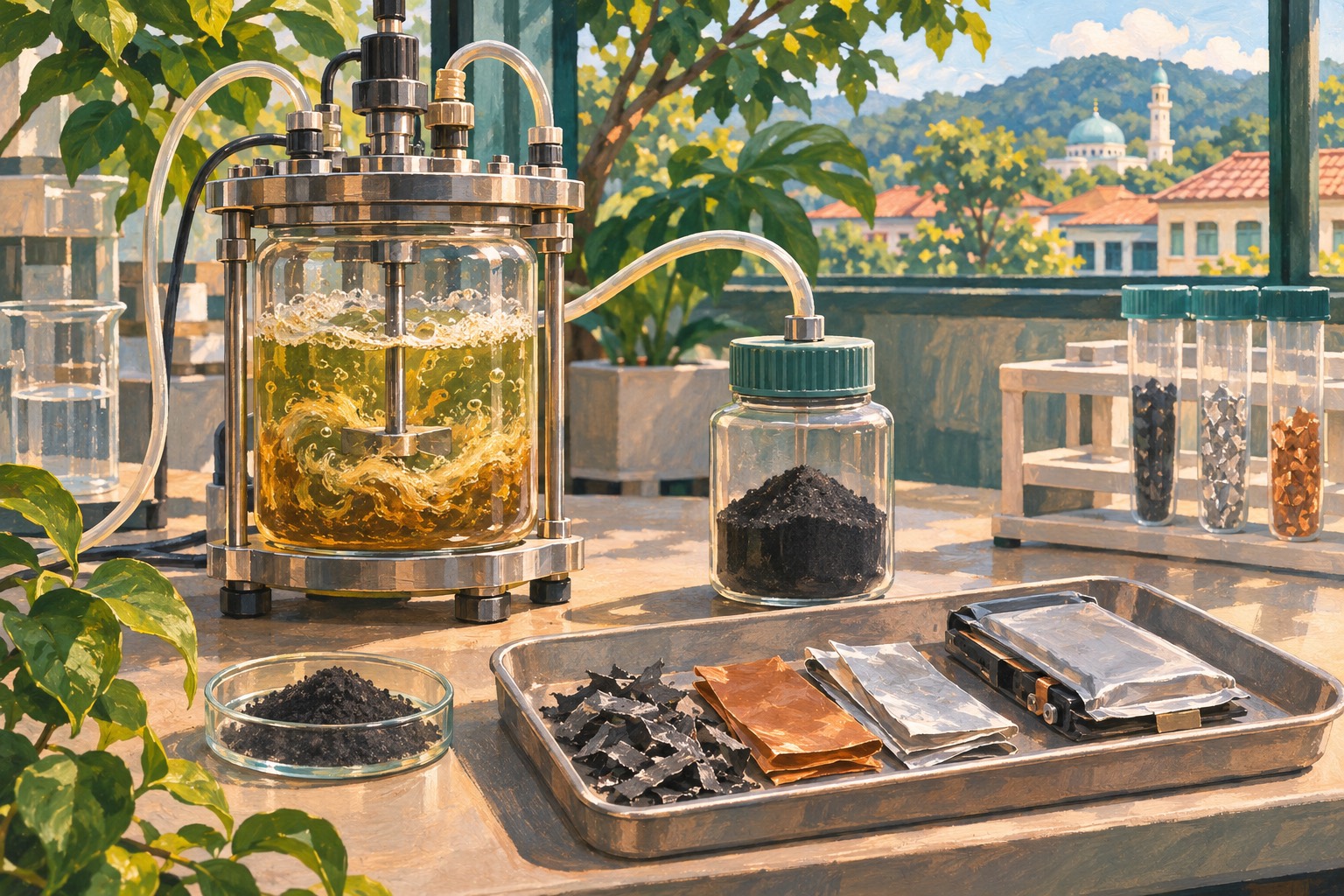
An electric vehicle battery can spend years moving a car. What happens to its materials afterwards is a different engineering challenge — and a British research team thinks microorganisms could help with one particularly awkward ingredient.
Researchers at the University of Surrey are developing a prototype to recover lithium from material left after old EV batteries are processed. Their project, called ReLiFE, will test a continuous-flow system on real battery waste supplied by industry partners.
The idea builds on earlier laboratory research in which the team says it recovered more than 90% of the lithium from synthetic battery material. The next step, announced on 19 November, is to see how the approach performs when the feedstock comes from recyclers and the process must keep running rather than stop after a single experiment.
It is an early-stage engineering project, not a service that EV owners can use today. But the problem it tackles is a practical one: batteries contain materials that could be valuable again if they can be recovered efficiently.
First, what is black mass?
An EV battery does not arrive at a recycling plant as a neat pile of separated lithium. Once batteries have been processed, shredded and separated, one output is a powder containing material from their electrodes. The industry commonly calls this powder “black mass”.
That powder can contain several valuable materials, and its exact composition varies with the batteries and processing methods involved. For a laboratory developing a new recovery process, a consistent synthetic mixture is useful for controlled testing. A recycler, however, must cope with material that can vary from one batch to another.
The Surrey researchers say their new prototype will use black mass supplied by industry partners. That is a meaningful change in the test: the process has to deal with actual input from a recycling operation, not just a carefully prepared laboratory mixture.
A second change is the planned continuous-flow design. Instead of treating one sample and stopping, the aim is to move material through a process that can operate continuously. The team will need to examine how well that works with changing inputs.
What do the microbes do?
The Surrey approach uses specially selected microorganisms that transfer electrons to help extract lithium from battery waste. The researchers say the process operates under relatively mild conditions and aims to reduce the use of chemicals compared with conventional routes.
The university links ReLiFE to an earlier project called BELIEVE, which explored bioelectrochemical lithium recovery. In the earlier laboratory work, the team reported recovering more than 90% of lithium from synthetic black mass.
Recovery and purity answer different questions. Recovery concerns how much lithium is taken out of the starting material. Purity concerns how clean the resulting lithium product is. A process can perform well on one measure and still need work on the other.
The new project aims to demonstrate purity above 99%, with a view to producing lithium hydroxide or lithium carbonate suitable for future battery production. That figure is a goal for the prototype, not a result the university has already established for real-world industrial operation.
Why bother recovering lithium?
Lithium is used in many rechargeable batteries, including those fitted to EVs. As more vehicles and battery-powered products are used, the question of what happens when batteries reach the end of a particular application becomes more important.
Recycling offers a possible way to return some materials to supply chains. The UK government’s critical minerals strategy discusses recycling as part of a broader effort to secure access to materials used in technologies and infrastructure.
That does not mean all recycling methods perform alike. The University of Surrey says lithium has been difficult to recover efficiently and that some higher-yield conventional approaches rely on corrosive chemicals. The research team’s hope is to develop another route with a lower burden, then measure how it compares.
An earlier report on the BELIEVE work described the use of microbial electrochemical technology for lithium recovery. The new announcement advances that work to a proposed continuous prototype with real recycler-supplied inputs.
The difficult bit is making a process work repeatedly
A promising laboratory result answers only part of an engineer’s question. A recycler also needs to know whether equipment can handle the material it actually receives, how consistently the process performs and what it costs to operate.
The Surrey team plans to assess economic and environmental performance alongside the engineering. Those assessments matter because a process that works chemically may still face obstacles when energy use, equipment, handling and other practical requirements are taken into account.
Purity must also be measured in the output, not simply assumed from the method. If the project succeeds in producing a sufficiently pure lithium compound, further work would still be needed to understand where it fits in a commercial battery supply chain.
For now, the university describes a prototype to be built and tested. It has not announced a Malaysian installation or a date when this method will be used by Malaysian recyclers. Any implications for local battery processing are therefore indirect.
What could this mean for EV owners?
There is no new collection scheme or product for Malaysian motorists in this announcement. Owners dealing with a damaged or end-of-life EV battery should use the vehicle maker’s authorised channels and follow local disposal requirements, rather than dismantle a high-voltage pack themselves.
For people watching the EV industry, the development is a useful example of why battery recycling is more than a single machine at the end of a vehicle’s life. Collection, safe processing, material separation and the quality of the recovered output all play a part.
The researchers’ immediate test is narrower: can their microbial system perform with real black mass in a continuous prototype, while producing lithium of the desired purity? The answer will come from the trial and the accompanying cost and environmental assessments.
If the results hold up, the approach could give recyclers another option to investigate. Until then, the most interesting part is the experiment itself: using microscopic organisms to help solve a very large materials problem.
Sources & further reading
Prepared with AI assistance from linked reporting. The cover is an AI-generated editorial illustration. Spotted something we should correct?