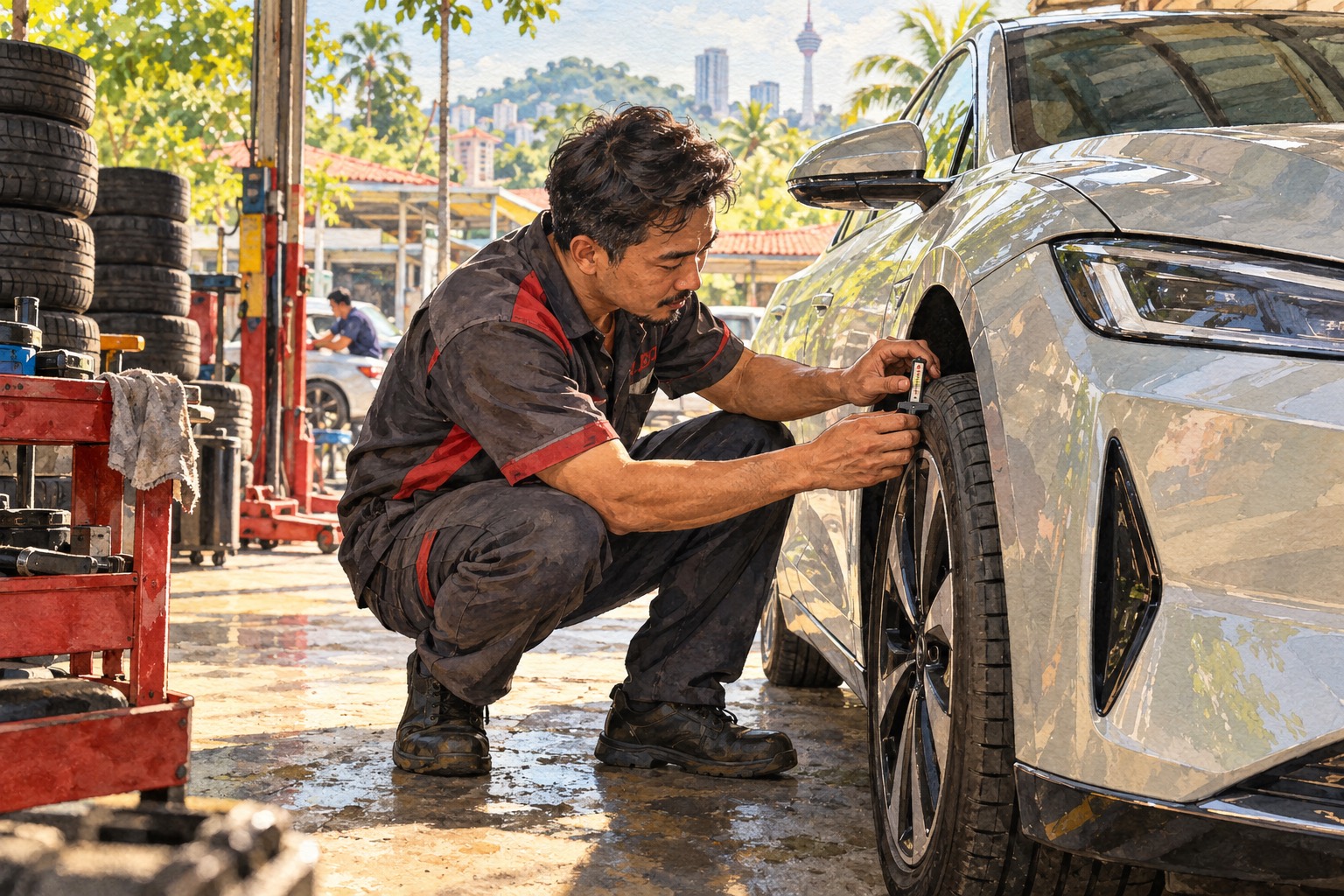
The next workshop visit can feel comfortably far away when you switch to an EV. The tyres may need attention well before that date.
A Malaysian ownership guide published by Paul Tan on 29 October highlights the gap: fewer routine service visits can make it easier to overlook rotation and inspection. Tyres still carry the car, meet the road and wear with use, whatever powers the wheels.
The useful response is not to panic about every EV wearing out tyres at the same rate. It is to keep tyre care on a separate schedule, using the instructions for your model and wheel setup.
Start with your own manual
Tesla’s manual for the 2017–2023 Model 3 gives one concrete example: rotate at 10,000 kilometres, or when the tread-depth difference reaches 1.5 millimetres, whichever comes first. That is a model-specific reference, not a universal interval for every electric car.
Compare the tyre instructions with the main servicing schedule. If they differ, waiting for the next general service could mean missing the tyre interval. Record the last rotation mileage so you are comparing actual distances, rather than guessing from the purchase date.
Ask the workshop to check the setup before moving wheels. Some cars have different tyre sizes at the front and rear. These staggered arrangements cannot simply be rotated front to back.
Direction also matters. A tyre designed to roll in one direction has to remain correctly oriented. The right pattern comes from the vehicle and tyre specifications, not a standard diagram that happens to be on the wall.
A pressure reading needs the right reference
Michelin recommends checking pressure when tyres are cold. Its inflation guide describes tyres that have not been used for two hours, or have travelled only a short distance at low speed. The principle is to avoid comparing a warmed-up reading with a cold-pressure recommendation.
Use the vehicle’s specified pressure, usually available on its placard and in its documentation. The maximum figure on the tyre sidewall is not a replacement for the carmaker’s instructions.
A hot reading also does not mean you should release air to force it down to the cold figure. Michelin specifically warns against deflating a warm tyre simply because pressure rises with temperature. Recheck under the proper conditions.
This is a useful habit for a car that spends its time between home, work and the shops. Put the check on the calendar. Michelin’s tyre-care guidance recommends monthly pressure checks because tyres can gradually lose air without an obvious incident.
Look beyond the easiest patch of tread
A glance at the centre of a front tyre does not tell you the condition of its inner shoulder or the tyres at the back. Ask for an inspection across the tread, especially if wear looks uneven.
Michelin distinguishes common patterns: wear across both shoulders can be associated with underinflation, while wear concentrated in the centre can suggest overinflation. A worn edge can point towards alignment, and patchy wear can involve suspension or balance problems.
These are reasons to investigate, not a diagnosis to make from one phone photograph. A professional needs to check what is happening on the car before recommending an adjustment.
Michelin’s alignment guidance explains that alignment concerns the suspension’s wheel angles; balancing concerns the wheel-and-tyre assembly. Paying for one does not automatically address the other. Tell the workshop what you noticed, including a pull to one side, vibration or a recent pothole strike.
Buying replacements: bring the whole specification
The tyre’s dimensions are only part of the shopping list. Michelin’s selection guide also identifies load index and speed rating as compatibility checks. A familiar brand or an attractive price does not settle those requirements.
The load index relates to the weight a tyre is certified to support under specified conditions. It is especially unwise to ignore that number because the replacement happens to be advertised for electric cars.
Ask the seller to match the vehicle’s approved specification, including any particular original-equipment requirements. Make sure the quotation identifies the exact model and size rather than a broad range that happens to include your wheel diameter.
A claimed improvement in comfort or efficiency is a separate comparison. It should not distract from whether the tyre is suitable in the first place. For ordinary ownership, compatibility is the first filter; then compare the characteristics you need.
The lifting instructions deserve a moment too
Before the car leaves the ground, make sure the workshop knows where the manufacturer permits it to be supported. Tesla’s lifting instructions warn against putting lift pads beneath the battery or side rails and specify designated body points instead.
The same document says not to raise a Model 3 while its charging cable is connected, even if charging is inactive. It also warns that damage from incorrect lifting is not covered by its warranty.
This is a job for a properly equipped workshop following the correct instructions. There is no need for an owner to improvise support points under a car just to get a tyre changed. Have the manual available if the workshop needs to check your model.
Budget for the tyre you actually have
The fresh local guide includes prices spanning different sizes and tyre ranges. Those ranges are not like-for-like quotations for every EV. The useful number is the fitted cost for the exact approved tyre on your car, with the work and any additional charges clearly stated.
A rotation record, a monthly pressure check and a proper inspection will not make tyres last forever. They can help you notice a maintenance issue before you buy another set without addressing its cause.
Before your next general service, check the mileage since the tyres were last inspected. A longer gap between workshop visits is convenient; keeping a separate tyre reminder helps make sure it stays that way.
Sources & further reading
Prepared with AI assistance from linked reporting. The cover is an AI-generated editorial illustration. Spotted something we should correct?