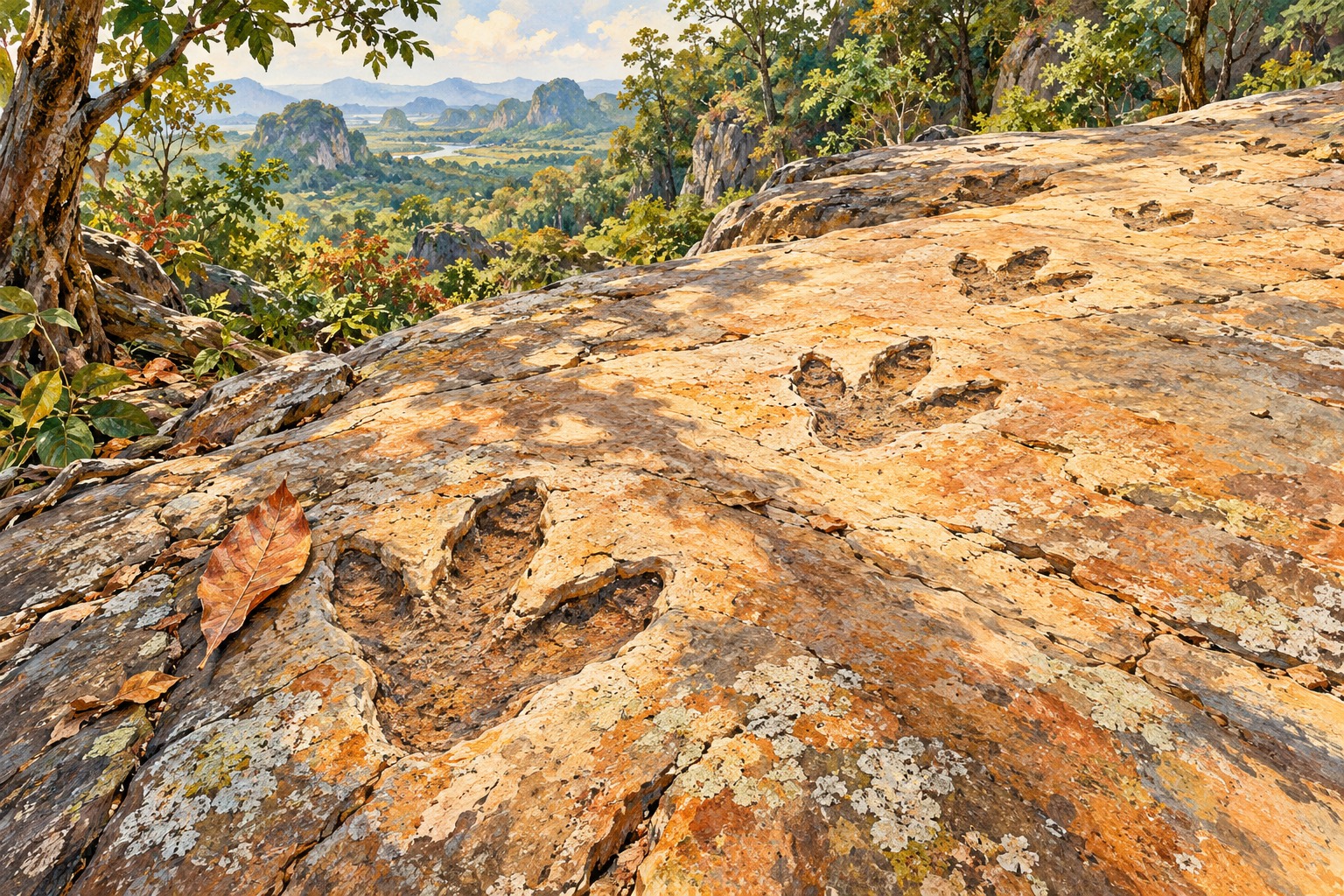
A curious find near a ranger station in Thailand has turned into a much older story. Officials say six impressions in the sandstone are dinosaur footprints dating back about 120 million years.
Thailand’s Department of Mineral Resources confirmed the Udon Thani trackway on 20 October, according to The Nation. The marks were made by a meat-eating theropod walking on two hind legs.
The discovery had attracted attention after a man identified as Pichai shared it in a Facebook group asking people to identify unusual finds. Earlier reporting by The Thaiger described the marks as possible tracks while officials investigated them.
What the rock can tell us
The Nation reports that the six prints form one trackway in sandstone of the Phu Phan Formation, from the Early Cretaceous. Individual prints have three pointed toes and measure about 29 centimetres long by 26 centimetres wide.
Officials estimate an animal about 6.3 metres long and 1.42 metres high at the hip. Those are reconstructions from the tracks, rather than measurements of a skeleton found alongside them.
A comparison with Siamotyrannus isanensis concerns the estimated size. It does not establish that this particular species left the marks.
First curiosity, then a closer look
The find was reported near ranger station No. 3 at Phu Phra Bat, in Ban Phue district. The early account focused on the visitor’s question and officials checking the impressions; the later confirmation provides the stronger basis for calling them dinosaur tracks.
For Malaysian readers planning a trip, the discovery is worth following as a developing heritage story. It is not yet a newly opened visitor attraction with confirmed arrangements announced in these reports.
Authorities are coordinating protection against visitor disturbance and water erosion while considering the site’s educational and tourism potential. The interesting next step is how to let people learn from those ancient footsteps without damaging the stone that preserved them.
Sources & further reading
Prepared with AI assistance from linked reporting. The cover is an AI-generated editorial illustration. Spotted something we should correct?