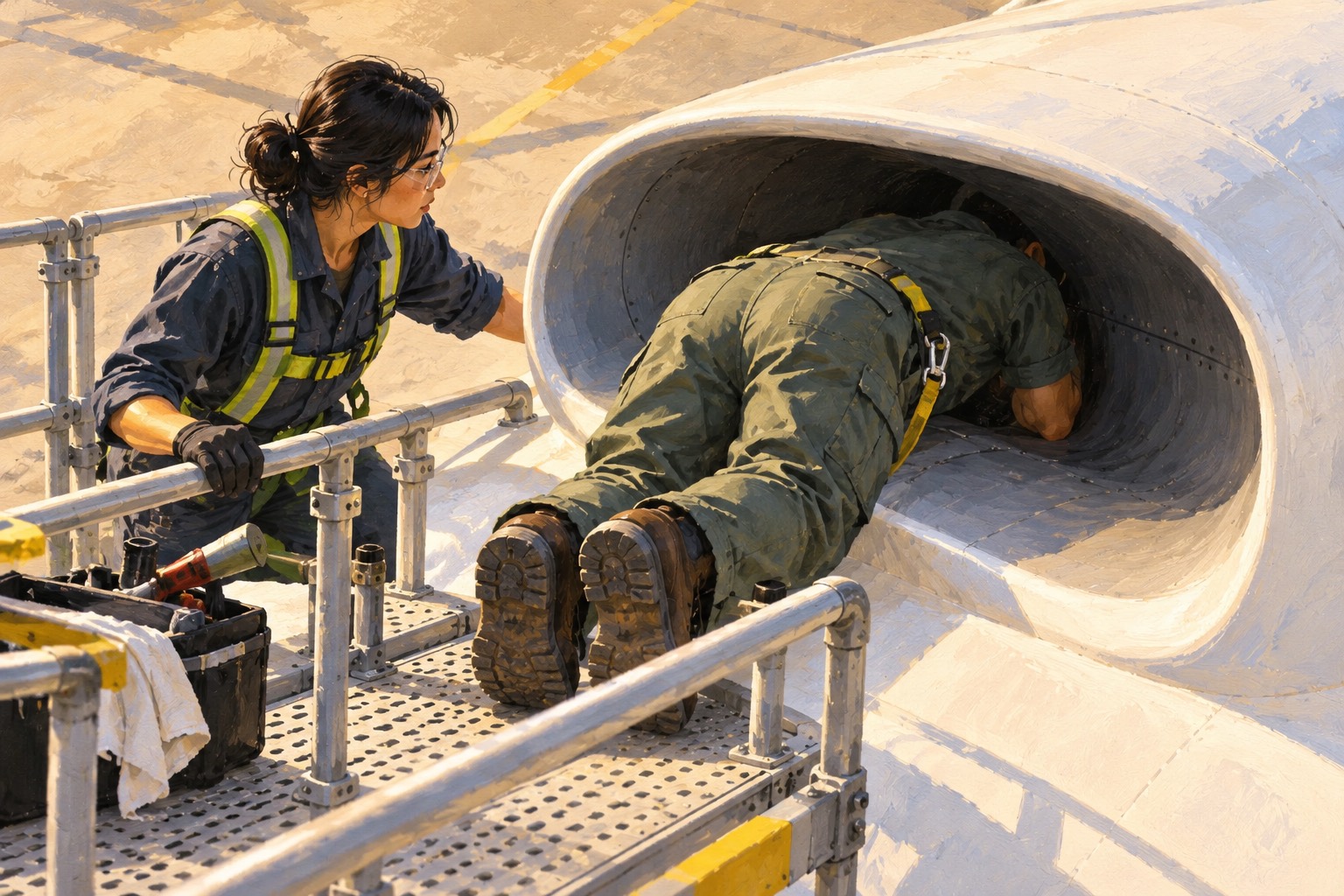
One of the jobs keeping NASA’s experimental X-59 flying involves a mechanic disappearing headfirst into its engine inlet. A second crew member stays outside as a spotter, while the person inside checks the cramped passage with a flashlight.
It looks like an unusually awkward way to spend a working day. NASA’s new maintenance account, published on 16 October, explains why this very human inspection still matters aboard an aircraft built for a sophisticated experiment in quieter supersonic flight.
The scene described happened on 30 April, during a pause between the aircraft’s eleventh and twelfth flights. It is an older maintenance moment shared in a fresh account, rather than a claim that the mechanic climbed inside yesterday.
A torch, a tight fit and someone watching outside
Lockheed Martin Skunk Works mechanic Jonathan Reynaga is the person pictured entering the duct. The opening is about shoulder-width, and the angle means his head ends up lower than his feet.
He is checking the engine’s fan blades and other components for signs that something has gone wrong. Special sensors used to measure engine performance are also inside, making careful movement particularly important.
The spotter stays with him throughout. After several minutes, Reynaga backs out again. NASA describes the procedure as a normal part of the aircraft’s maintenance routine, not an improvised stunt or a dramatic rescue.
The work happens while the aircraft is stationary and being prepared between flights. This is a specialist crew carrying out an established inspection; the photographs are not a how-to guide for anyone approaching an aircraft on their own.
Shade matters too. The desert conditions can exceed 100 degrees Fahrenheit, and the jet needs time to cool after flying. The maintenance team has to manage the heat around the aircraft as well as the narrow space inside it.
What are they looking for?
NASA deputy propulsion lead Paul Dees explains that the inspection looks for possible damage, including damage from foreign objects or debris. An engine can be affected by material that should never have reached its moving parts.
A visual look inside gives the crew another way to assess its condition. NASA says a duct dive and an inspection of the exhaust take place after every flight, alongside more detailed maintenance work.
That does not mean the team expects damage every time. At the time of the new report, the X-59 had made 38 flights and the inspections had found no engine damage.
It is a reassuring finding with a clear boundary: it describes the flights completed when NASA wrote the account. It is not a guarantee about future flights, and it does not make routine checking unnecessary.
The unglamorous repetition is the point. A research flight produces useful data, but the aircraft still needs people to check that it is ready to go up again. A clean inspection is a result the crew wants to keep earning.
Even ducts have a comfort ranking
NASA’s account compares the X-59 with other research aircraft the team knows. An F-15’s deeper, rectangular inlet gives a person comparatively more room. An F/A-18’s rounded, tighter, curved passage is less comfortable to inspect.
X-59 crew chief Juan Salazar says this aircraft’s inlet has a similar diameter to an F/A-18’s but is shallower, making the job easier. Easier is relative when the task still involves putting your upper body into a narrow engine passage.
That comparison brings an aircraft-design story down to a very tangible scale. The same engineering choices that affect airflow also determine how a maintenance worker can reach the parts that need checking.
Why put the engine inlet up there?
The X-59 takes in air above its wing rather than through a low-mounted inlet. NASA explains that this arrangement helps keep shock waves from merging into the loud boom associated with conventional supersonic aircraft.
It has another practical consequence: the inlet is less exposed to debris on the runway. That reduces a route by which unwanted material could reach the engine, even though it does not remove the need to inspect it.
The aircraft’s unusual shape serves the broader Quesst mission. NASA wants to demonstrate flight faster than sound with a softer sonic thump, then gather information about how communities respond when it flies overhead.
Those responses are intended to help regulators consider acceptable noise limits. The aircraft is a research demonstrator, not a passenger service with tickets available, and its flights do not automatically grant commercial supersonic approval.
A sonic boom is not just one barrier-breaking bang
NASA’s August explainer tackles a common misunderstanding. A sonic boom is not merely the noise produced at the instant an aircraft crosses the speed of sound. Shock waves keep forming as it continues flying faster than sound.
Waves arise around the nose, cockpit, wings, inlet and other features. As they travel towards the ground, they can combine. The result spreads over a broad strip beneath the flight path rather than remaining at one point in the sky.
The aircraft’s shape, its path and atmospheric conditions all affect what people hear. Neighbours can experience the same flight differently. That is why research needs more than a claim that a design looks quieter on paper.
NASA uses modelling, wind tunnels, sensors, microphones and community-response work to investigate those effects. The distinctive inlet belongs within that much larger effort to shape and measure the sound reaching the ground.
And before the next flight can add another set of measurements, someone has to check the machine itself. For all the advanced research surrounding the X-59, one essential view still comes from a trained mechanic with a flashlight, carefully looking into a very tight space.
Sources & further reading
Prepared with AI assistance from linked reporting. The cover is an AI-generated editorial illustration. Spotted something we should correct?