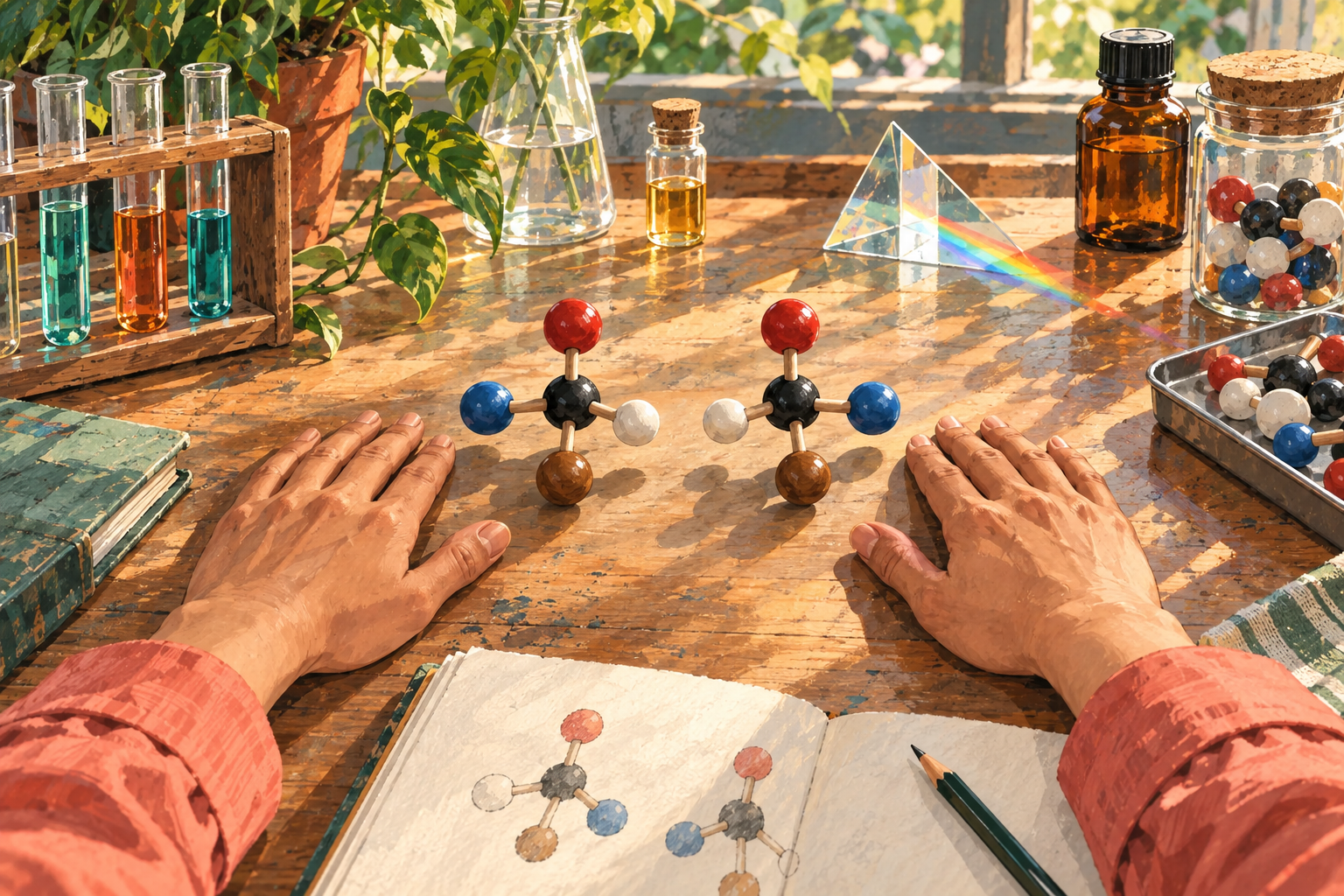
Put your hands side by side. They have the same fingers, yet you cannot rotate a left hand until it becomes a right hand. Some molecules have a similar problem, and choosing the correct version can matter enormously when making a medicine.
On 7 October, Henri B. Kagan and Kenso Soai won the 2026 Nobel Prize in Chemistry for discoveries that help reactions favour one molecular mirror image. Their work tackles a question that sounds wonderfully strange: how can chemistry become one-handed?
Kagan worked at Université Paris-Sud in France; Soai is associated with Tokyo University of Science in Japan. The Nobel announcement recognises their discoveries of non-linear effects and autocatalysis in asymmetric organic synthesis.
That formal description takes a little unpacking. Underneath it is a story about shape, feedback and the difference between producing a mixture and steering a reaction towards the version you want.
Same ingredients, different fit
Chemists call this property chirality. Two forms that mirror each other without being superimposable are enantiomers. It is their three-dimensional arrangement that differs, rather than a simple change in the list of ingredients.
An ordinary comparison helps: left and right shoes can use the same materials, but changing their position does not make them fit the same foot. Molecules interact in a three-dimensional world too, so their arrangement can change how they behave around other molecules.
This is why a molecular mirror image cannot automatically be treated as an interchangeable copy. A useful substance needs the right properties in the biological setting where it will act. Merely recognising its ingredients leaves an important part of the story out.
The Nobel background explains that this matters for pharmaceuticals, and also for substances such as flavours, fragrances and agricultural chemicals. Controlling a reaction can therefore be about the shape of its product as much as the amount produced.
Life has a preference, chemistry needs a method
The academy describes life’s chemistry as homochiral: it preferentially uses one molecular handedness in key building blocks. Proteins use one family of amino-acid forms, while the sugars in DNA also have a particular handedness.
A reaction in a laboratory does not automatically share that preference. If the two forms are produced equally, chemists face a mixture when their intended application may require a particular form.
There are two questions here. One is practical: how do you make more of the desired version? The other asks how such a strong preference could arise at all. Kagan and Soai contributed tools that connect those questions, although their experiments do not establish exactly what happened when life began.
That distinction keeps the story interesting without turning it into a claim the experiments cannot support. A demonstrated route to asymmetry is a powerful result in its own right.
Kagan found that a small bias could become bigger
Kagan’s breakthrough, described in work from 1986, challenged the assumption that the handedness of a catalyst would translate into the product in a straightforward proportion.
A catalyst helps drive a reaction. In the systems Kagan investigated, combining different mirrored forms in the catalyst could produce an unexpectedly strong excess of one product form. Plotting the relationship gave a curve rather than the simple straight line chemists had expected.
That is the non-linear part of the prize. A small starting preference could be amplified. More importantly, studying the effect provided clues about how the reaction worked, helping chemists design and improve their methods.
Imagine adjusting an input and finding that the output changes more strongly than a simple proportional rule predicts. The surprise becomes useful when you can explain it and reproduce it, rather than merely noticing that one trial behaved differently.
Soai made the product help make more of itself
Soai pursued autocatalysis, in which a product contributes to the process that creates more of that product. It is feedback written into a chemical reaction.
His 1995 work demonstrated an asymmetric autocatalytic reaction, and later work in 2003 achieved a far stronger selection of one mirror image. The Nobel background describes how a tiny initial excess can be reinforced until one form overwhelmingly dominates.
In repeated experiments, the opposite form can dominate instead. The significance lies in amplification: a very small imbalance can grow, rather than staying close to an even split.
A 2004 scientific perspective by chemist Donna Blackmond makes an important point: autocatalysis alone does not guarantee that one mirror image will take over. The way the reaction favours and suppresses different forms matters too. Simply making more of a product could preserve a mixture rather than amplify its imbalance.
That helps explain why the experiment is remarkable. The achievement involves a particular chemical system that reinforces a preference, not a universal rule that any molecule making more of itself will become one-handed.
The reaction is artificial, and different from the chemistry of living organisms. It gives researchers a way to investigate how handedness can emerge, while leaving the historical origin-of-life question open for further evidence.
This field has changed medicine before
There is a longer Nobel trail behind today’s award. In 2001, William Knowles, Ryoji Noyori and Barry Sharpless were recognised for catalytic asymmetric synthesis involving hydrogenation and oxidation reactions.
The academy’s announcement linked Knowles’s work to an industrial method of making L-DOPA, used in Parkinson’s treatment. It also described applications of the wider research in manufacturing antibiotics, anti-inflammatory medicines and heart medicines.
That history helps explain why control over molecular handedness earns so much attention. A method that selects a desired form can become useful far beyond the original laboratory experiment. It offers a way to make chemistry more deliberate at a stage where precision matters.
In 2021, Benjamin List and David MacMillan received the chemistry prize for asymmetric organocatalysis. Their approach used small organic molecules as catalysts, expanding a toolbox previously associated principally with metals and enzymes.
The academy described those catalysts as tools for building molecules more efficiently, with effects on pharmaceutical research and greener chemistry. Different awards recognise different methods, but they share a concern with steering construction rather than accepting whatever mixture emerges.
Today’s mirror-image story joins that chain. A left hand remains a left hand however you turn it. The chemists’ achievement was learning how to make the reaction choose.
Sources & further reading
Prepared with AI assistance from linked reporting. The cover is an AI-generated editorial illustration. Spotted something we should correct?