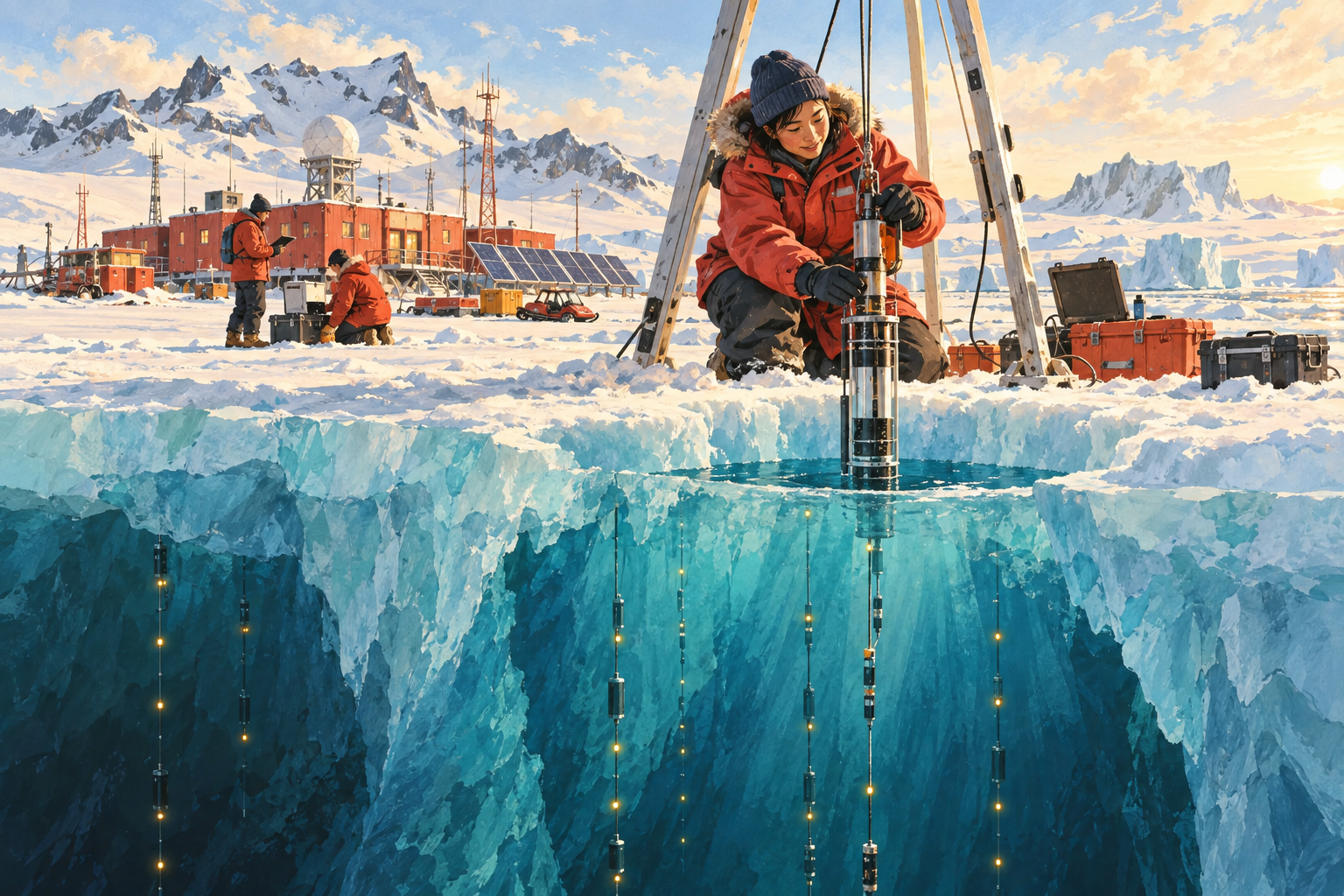
Most telescopes point a lens towards the sky. IceCube hides thousands of its eyes deep inside Antarctic ice.
That unusual observatory is back in the spotlight after the University of Wisconsin–Madison announced on 6 October that physicist Francis Halzen had been named a 2026 Nobel laureate in physics for neutrino astrophysics. Halzen is IceCube's principal investigator.
The project sounds like science fiction: use a cubic kilometre of ice near the South Pole to look for clues from far beyond our solar system. The working method is stranger — and more precise — than simply photographing space.
The ice becomes part of the instrument
According to IceCube's own description, 5,160 digital optical modules sit on 86 strings. The main array extends to depths of about 1,450 to 2,450 metres beneath the surface.
Neutrinos rarely interact with matter. When an interaction does happen, it can produce charged particles that leave a faint light signal in the ice. The sensors record that light, including its timing, so researchers can reconstruct the event's direction and energy.
The light is called Cherenkov radiation. A particle can travel faster than light travels through ice; that does not mean it has exceeded the speed of light in a vacuum. The distinction keeps this remarkable instrument firmly within physics rather than a faster-than-light fantasy.
Why chase particles that barely notice anything?
The university explains that neutrinos can travel largely undisturbed through the universe. Unlike charged cosmic rays, their paths are not bent in the same way by magnetic fields.
That makes them potentially useful messengers from energetic, distant events. If scientists can work out where they came from, they gain a different view of the cosmos from the one offered by ordinary light.
UW–Madison's account highlights IceCube's detection of high-energy neutrinos beyond the solar system in 2013 and subsequent work linking neutrinos to cosmic sources. This is a long-running scientific effort, not an observatory switched on for this week's announcement.
The neat twist is that its view of the universe depends on looking down as well as out. Beneath an apparently quiet frozen landscape, thousands of sensors wait for the occasional flash that can tell researchers something about a much more distant place.
Sources & further reading
Prepared with AI assistance from linked reporting. The cover is an AI-generated editorial illustration. Spotted something we should correct?