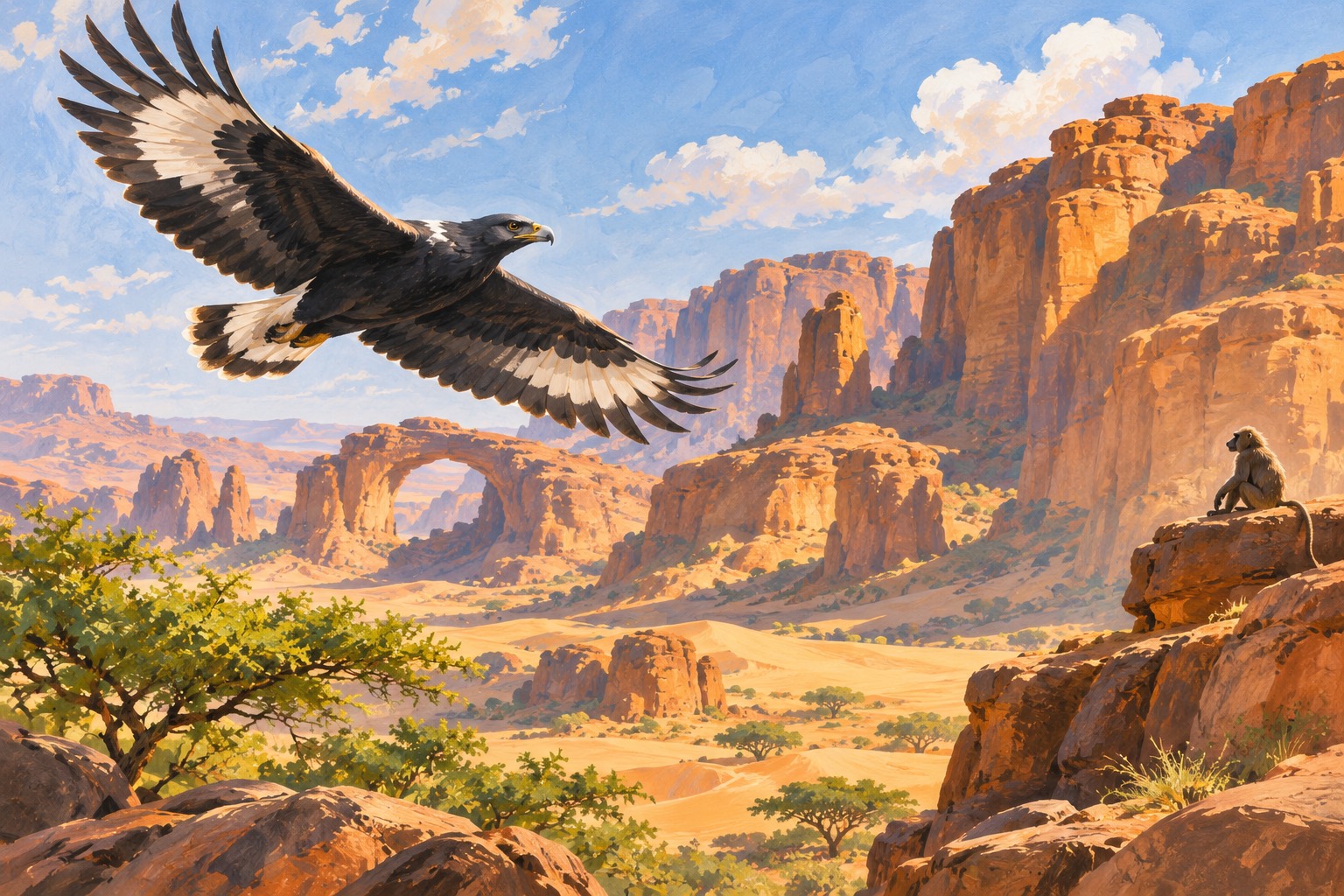
High in the rocky landscape of northern Chad, a set of baboon bones has raised an unexpected question: could an eagle attack a primate much larger than scientists had previously confirmed?
A team including researchers from the University of St Andrews studied remains from an isolated baboon population on the Ennedi plateau. They found punctures and marks on skulls and shoulder bones that they describe as evidence of eagle predation.
One individual was estimated to have weighed more than 26kg, the university said in a release on 19 November. The findings appeared in the American Journal of Biological Anthropology.
A clue from the bones
Eagles are known to prey on primates, but researchers had considered larger primates less vulnerable partly because of their size. The new evidence challenges that assumption for at least this population and setting.
The finding comes from marks on remains. It is evidence used to infer predation, rather than a claim that researchers filmed every attack. The work involved researchers from institutions including St Andrews, Dartmouth College, the University of Konstanz, the Max Planck Institute of Animal Behaviour and African Parks.
The Ennedi baboons live around gueltas, pockets of water in rock formations in the Sahara. African Parks researcher Jean Didier Akpona said the team had observed Verreaux’s eagles in the region and that the discovery prompted more questions about the area’s wildlife.
The researchers also suggest the evidence could inform discussions about how early human relatives responded to predators. That is an avenue for further investigation: the Chad baboons are living animals in a particular environment, not direct proof of how every human ancestor behaved.
For now, the remarkable image is a scientific puzzle written into bone: a large primate, a desert landscape and signs that an aerial predator may have been part of the story.
Sources & further reading
Prepared with AI assistance from linked reporting. The cover is an AI-generated editorial illustration. Spotted something we should correct?