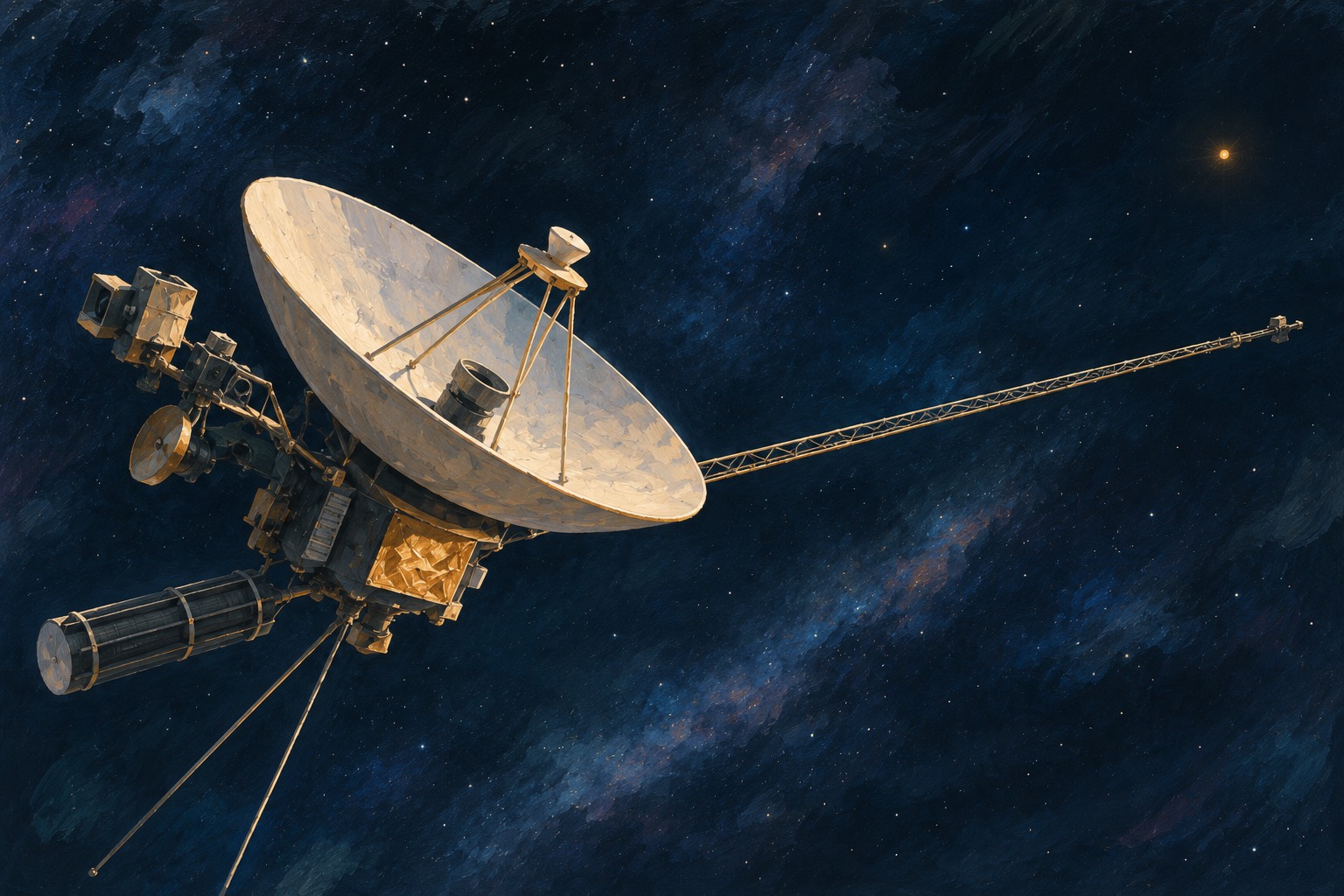
A message to Voyager 1 now has a very long wait for a reply. NASA calculated that the spacecraft reached one light-day from Earth on 18 November 2026 — roughly 25.9 billion kilometres away.
At that distance, a radio signal travelling at the speed of light takes about 24 hours to reach the probe. A response takes another 24 hours to get back. So even a simple exchange with the spacecraft requires roughly two days, before allowing for any work on the ground.
NASA calculated the crossing for 10.16am UTC on Wednesday, or 6.16pm in Malaysia. Reuters reported that mission officials would have to wait about a day for a signal from the spacecraft to confirm it had reached the distance. The milestone is based on the team's calculations, rather than a photograph taken at a signpost in space.
A journey that began in 1977
Voyager 1 launched in September 1977. Its early tour brought close-up observations of Jupiter and Saturn, changing how scientists could study the planets and their moons. Its twin, Voyager 2, went on to visit Uranus and Neptune as well.
In 2012, Voyager 1 crossed the heliopause, the boundary where the Sun's outward flow of particles meets the interstellar medium. NASA describes the two Voyagers as the first and only spacecraft to enter interstellar space, where they continue to send information back.
They are still within the wider gravitational reach of the Sun. Interstellar space, in this context, describes the environment beyond the Sun's protective bubble of solar wind — not a sudden arrival at another star.
The long-distance conversation
One light-day is a distance: the length light travels in 24 hours. NASA puts that at about 25.89 billion kilometres. The same speed limit applies to the radio signals the mission uses to communicate.
That delay changes how the flight team works. Engineers cannot steer or troubleshoot the probe as if it were a car responding immediately to a driver. They have to plan commands and wait for the answer to cross the enormous gap.
Both spacecraft carry a Golden Record containing sounds and images selected to represent life on Earth. Most of us will never get anywhere near their route, but the mission's images and measurements remain available through NASA's Voyager pages — a useful starting point for anyone who wants to follow the journey.
Sources & further reading
Prepared with AI assistance from linked reporting. The cover is an AI-generated editorial illustration. Spotted something we should correct?