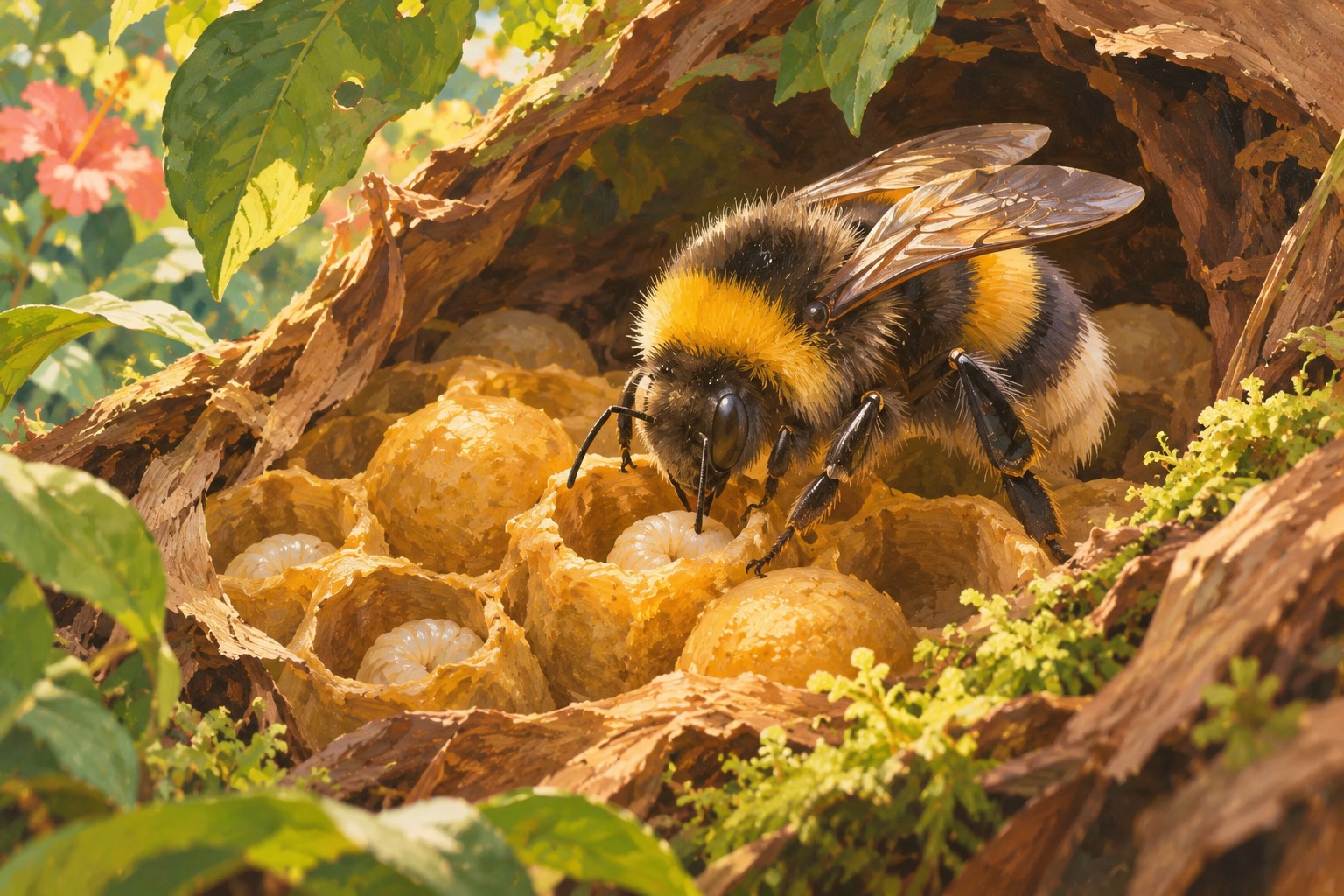
Male bumblebees have long been given a rather narrow job description: grow up, leave the nest and find a queen to mate with. A new study suggests some of them can also help with the nursery.
Researchers at the University of California, Riverside spotted males warming eggs and larvae in the nest. When the team tested queen-led colonies in the laboratory, nests containing males began producing eggs sooner and ended up with more young, according to the university’s account of the study.
The discovery began with a heat camera. Researcher Meghan Moore was photographing nests for another experiment when she noticed hot spots coming from male bees. The insects were positioned over the developing brood, their bodies touching it in an incubation posture.
A little help for the queen
To investigate, Moore and colleagues set up laboratory nests, each with a mated queen and either no males, one male, three males or five males. The experimental nests contained no female workers.
Over roughly a month, the team tracked the bees’ body temperatures, when queens laid eggs and how much brood each nest produced. The males in the warming posture had elevated thorax temperatures – about 34.8°C compared with roughly 31°C otherwise – indicating that they were generating heat.
The researchers reported that queens housed with males started laying eggs about twice as quickly, and the nests produced up to 1.5 times as much brood. Their findings were published in Royal Society Open Science.
What happens outside the lab?
Finding a bumblebee nest in the wild is difficult; watching its inhabitants closely is harder still. The researchers therefore used an artificial setup in which males could not leave, and early natural nests do not normally have the same mix of inhabitants as the test nests.
The team wants to learn more about what the warming work costs the males and how often similar care occurs in nature. A smaller observation found some male care even when female workers were present, the researchers said.
For readers, the surprise is a reminder that even familiar insects can hold secrets about family life. For scientists studying threatened bumblebees, understanding who does what inside a colony adds another piece to the puzzle of how nests develop.
Prepared with AI assistance from linked reporting. The cover is an AI-generated editorial illustration. Spotted something we should correct?