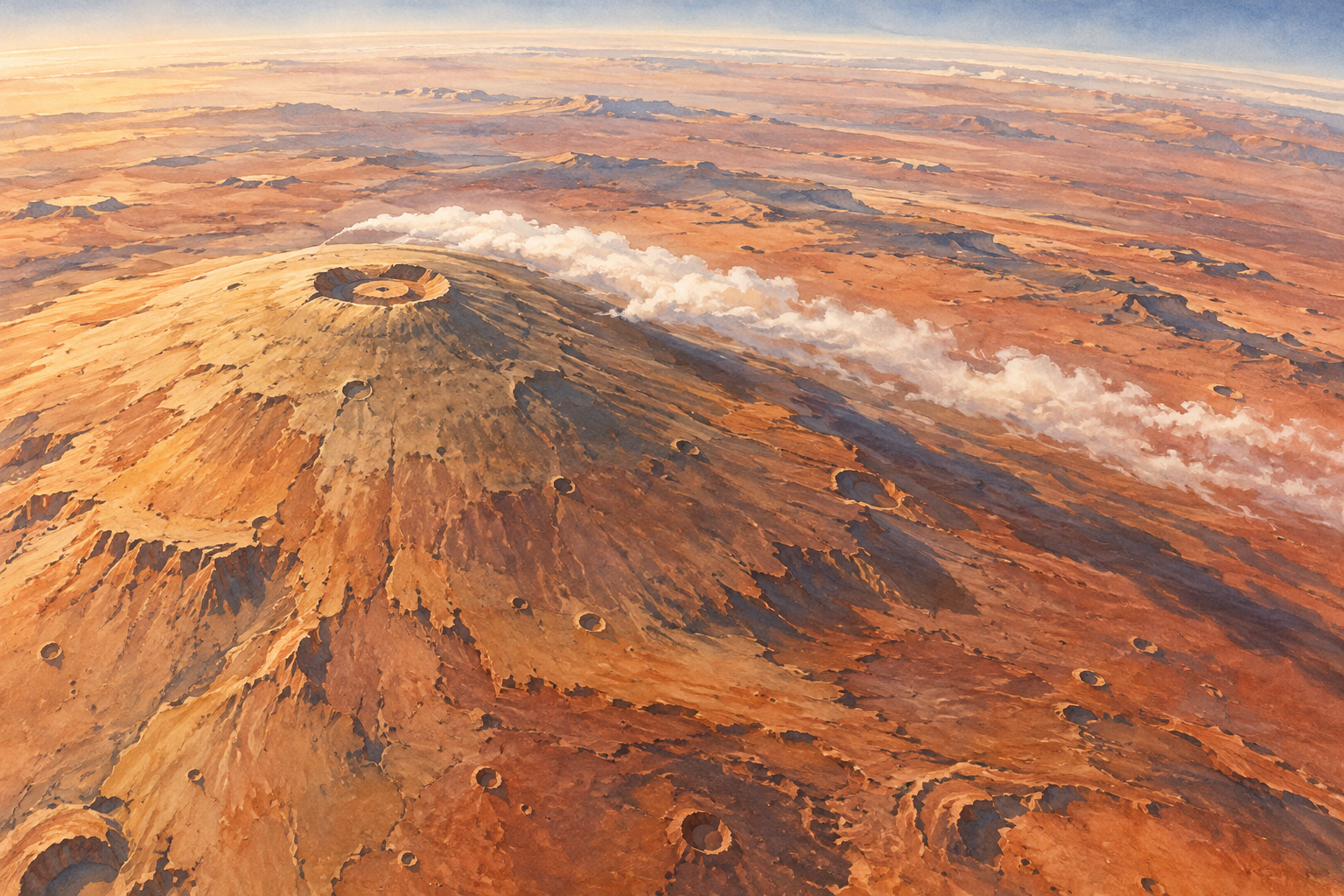
A white cloud stretching up to 1,800 kilometres across Mars sounds like the start of a science-fiction mystery. The explanation scientists are investigating is unusual enough without adding aliens or an erupting volcano.
Fresh coverage by BBC Sky at Night Magazine on 9 October highlights research into the Arsia Mons Elongated Cloud. Scientists have reproduced its distinctive behaviour in a model by including a process that conventional cloud modelling had not treated as a realistic explanation.
The result is fascinating. It also needs a little care: a successful model is evidence for an explanation, not a claim that every detail of Martian weather is now settled.
First, that white trail is water ice
The cloud appears downwind of Arsia Mons, a huge shield volcano. ESA describes the mountain as roughly 20 kilometres tall, a substantial obstacle for air moving across the landscape.
Its long trail can look like something pouring out of the volcano. ESA’s earlier observations explain that it is a water-ice cloud associated with airflow around the mountain, rather than a plume from volcanic activity.
The feature grows and fades during a daily cycle in southern Martian spring and summer. The timing matters: this is a recurring atmospheric phenomenon, not a permanent white stripe painted across the planet.
An ESA image released with the new work shows a cloud around 980 kilometres long in a frame covering a region just under 1,250 kilometres across. The maximum length and the length in one particular photograph should not be confused.
The puzzle was making the model behave like the sky
Researchers had already identified the feature as an orographic cloud, meaning one associated with air flowing over mountainous terrain. The difficult part was reproducing its formation with the usual cloud physics.
The study’s authors report that adding homogeneous nucleation allowed their Martian meteorological model to reproduce the cloud’s unusual characteristics. The paper’s public preprint describes this as evidence for the process occurring in a planetary atmosphere.
That is a more specific finding than simply discovering that Mars has clouds. Scientists are investigating the mechanism that turns water vapour into the icy particles making up this particular feature.
The preprint is available publicly, while ESA identifies the related study published in Nature Geoscience. Readers should keep those versions distinct: the preprint page itself says that its posted version has not undergone peer review or subsequent corrections.
What makes this process unusual?
Cloud formation usually involves water gathering on tiny particles already present in the atmosphere. Those particles can include dust, salt or other material. Scientists call that heterogeneous nucleation.
Homogeneous nucleation removes that starting surface from the explanation. In the proposed mechanism, water vapour forms icy particles directly, without first gathering on a pre-existing dry particle.
ESA reports that the mountain generates a powerful atmospheric wave, rapidly lifting moist air. The rising air cools, with temperatures in the model falling by around 30 degrees in ten minutes, helping produce exceptional conditions for the process.
The startling humidity comparison in the reporting concerns extreme relative humidity. It should not be read as saying that Mars contains more total atmospheric water than Earth, or that the whole planet suddenly becomes a tropical steam room.
The comparison images show progress, and limits
ESA has published a side-by-side view of observations and a simulation. The upper view uses Mars Express Visual Monitoring Camera observations previously released in 2021; the lower view shows the new regional atmospheric modelling.
The cloud emerges in both as the sequence advances. ESA notes differences in timing, duration and length, while describing the resemblance as a major success given the much smaller amount of atmospheric information available for Mars.
That qualification is worth retaining when sharing an exciting result. The researchers have found a promising way to reproduce the phenomenon, while some aspects still differ from what the spacecraft recorded.
A model earns attention by explaining observations. Its remaining differences are useful information too, because they help show where the explanation can be tested and improved.
Catching it requires being there at the right time
The observation schedule helps explain why this cloud became such a distinctive Mars Express story. ESA’s earlier account describes the feature growing during the morning and disappearing only hours later.
Many orbiting spacecraft tend to observe in the afternoon. An instrument looking at the right place after the cloud has faded can miss the event even though the phenomenon occurred that day.
Mars Express combines an elliptical orbit with a wide-field camera that can observe large areas in the early morning. That combination lets researchers follow a feature that is both very long and short-lived.
The earlier reporting describes repetition over around 80 days or more during the relevant season. It also distinguishes the Martian day, or sol, from an Earth day: a sol lasts approximately 24 hours and 39 minutes.
Different instruments add different kinds of information
Mars Express is more than a single camera taking attractive pictures. ESA’s instrument guide describes a high-resolution stereo camera that can provide colour imagery and terrain information, helping establish the landscape around an atmospheric feature.
The OMEGA instrument works with visible and infrared light to map mineral composition, and can also measure atmospheric composition as reflected light passes through the atmosphere.
The mission’s instrument list additionally includes equipment for examining atmospheric structure, plasma and the subsurface. Those broader capabilities place the cloud observations within a sustained scientific mission rather than a one-off image collection.
For this study, ESA says researchers used information from the Visual Monitoring Camera, High Resolution Stereo Camera and OMEGA. Combining observations with a model is what allows a striking shape in a photograph to become a question scientists can investigate.
The best part is how ordinary the starting question feels
A cloud appears, grows and disappears. On Earth, that might be something you notice during a morning walk. On Mars, its enormous scale and unusual conditions turn that familiar sequence into a test of atmospheric physics.
The new work does not turn the white trail into smoke, an alien signal or proof of an active eruption. It gives scientists a better explanation to test against the images they have been gathering.
That is plenty strange enough: a thin ribbon of ice over a distant mountain may be showing researchers a cloud-forming process they did not expect to see in nature.
Sources & further reading
Prepared with AI assistance from linked reporting. The cover is an AI-generated editorial illustration. Spotted something we should correct?