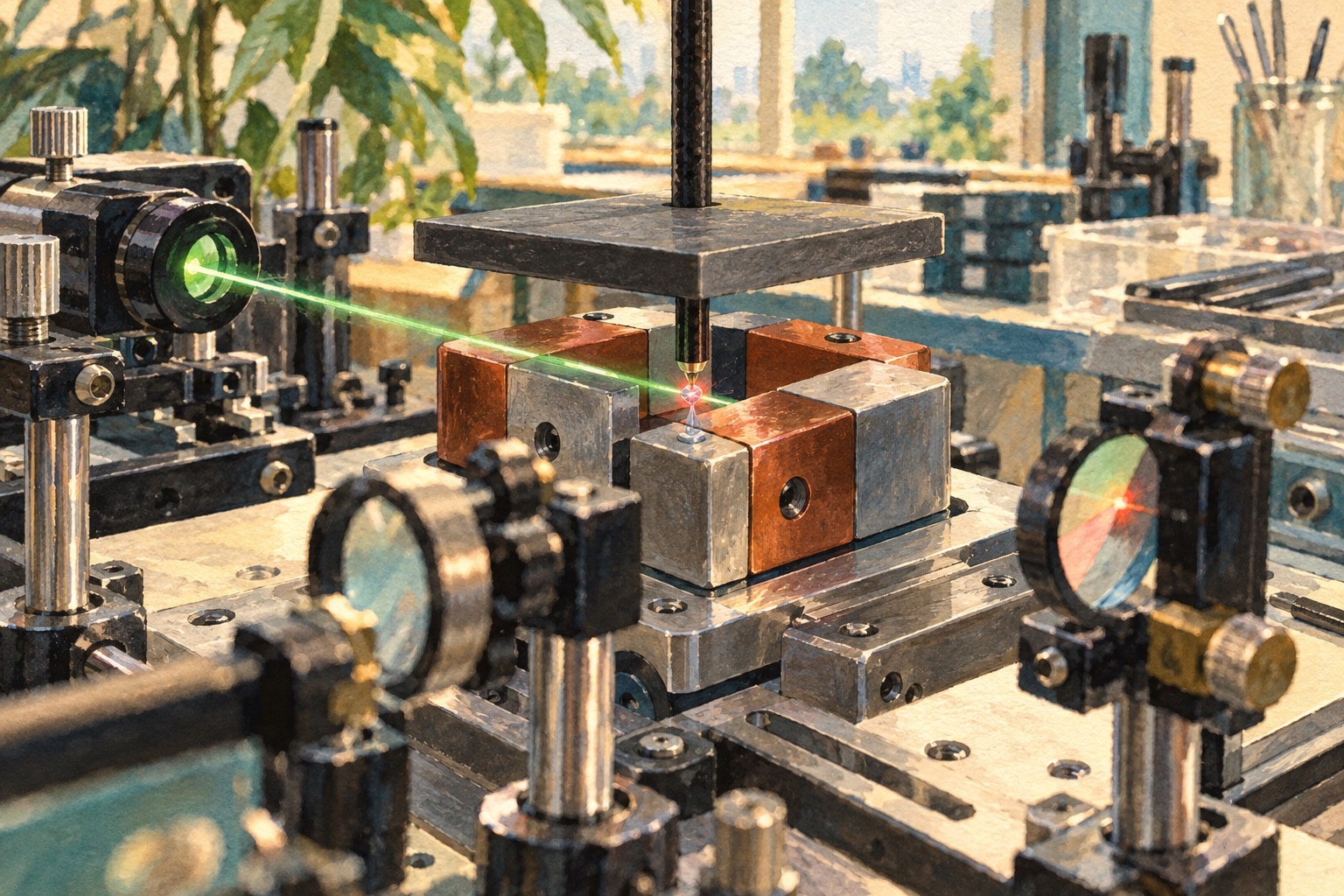
A tiny diamond helped move a much larger laboratory assembly without anyone giving it a mechanical push. The force came from quantum spins inside the diamond, controlled with light.
The result sounds like the beginning of a science-fiction scene. The actual movement was far smaller: more than 100 nanometres in the experiment described by the researchers. A nanometre is one billionth of a metre.
ScienceAlert highlighted the work on 10 October, following the Okinawa Institute of Science and Technology’s announcement. The interesting leap is in the size of the object being controlled, rather than the distance it travelled.
Something you could see moved by something you could not
The assembly weighed 128 milligrams—0.128 grams—and combined a diamond with a graphite structure held above magnets. Its centimetre-scale dimensions put it well beyond the individual particles people often picture in quantum experiments.
The diamond itself was about three millimetres across, according to ScienceAlert’s description. Calling the whole setup centimetre-scale does not mean a centimetre-sized diamond flew across the room.
It also does not mean the movement was a centimetre. Size and displacement are two different measurements here, and mixing them makes the result sound much more dramatic than it was.
For an everyday comparison, imagine being able to see a small object on a workbench while needing a precision instrument to detect its change in position. The object can be visible even when its motion is far below what your eyes resolve.
The diamond’s imperfections did the useful work
The key ingredients are nitrogen-vacancy centres: particular defects in the diamond crystal involving nitrogen and a neighbouring vacancy. They give researchers access to electron spins that can be controlled.
Spin is a quantum property, not a miniature ball visibly rotating inside the stone. NIST’s introductory explanation places it alongside other intrinsic particle properties, while distinguishing it from the ordinary spinning of something in a room.
That is why an illustration of a whirling diamond can be misleading. The experiment concerns the state of electrons and the magnetic force associated with those states, translated into motion of the larger apparatus.
The useful connection is between two scales. Researchers can change a microscopic property in the diamond, then measure a response in an assembly large enough to handle in a laboratory.
A green laser supplied the rhythm
OIST’s account describes using green laser light to prepare the spins. In the presence of a magnetic field that changes with position, changing those spin states changes the force on the diamond.
Pulsing the illumination in time with the apparatus’ natural motion builds up an oscillation. A playground swing offers a helpful analogy for the timing: repeated small inputs at the right moments can produce a clearer response than badly timed ones.
That analogy describes the rhythm, not the quantum mechanism. Nobody was pushing this apparatus like a swing, and the diamond was not being carried around by the laser as a visible beam of force.
The team measured the motion using optical interferometry. A mirror helped make the displacement readable, allowing a very small movement to become an experimental signal instead of a guess from a video.
Levitation helps keep unwanted contact out
A graphite plate above an arrangement of magnets supported the system. The diamond was connected to it, so the parts formed one mechanical assembly rather than a loose stone floating independently.
There is a practical reason for that choice. Contact with a normal support can introduce friction and other disturbances; a freely suspended system gives researchers another route to isolating the motion they want to study.
OIST has explored related ideas before. In October 2025, it described a centimetre-sized graphite rotor designed to avoid a form of magnetic drag called eddy-current damping during rotation.
That earlier work is background, not a second new discovery this week. It illustrates how much engineering can sit behind a deceptively simple picture of something hovering over magnets.
Geometry matters, and so does the surrounding environment. The institution’s earlier account explains that air friction still affects the rotor, even after the particular magnetic loss was addressed. Floating alone does not remove every source of disturbance.
The paper describes a force, not a teleportation trick
The team’s preprint, posted in May, identifies the central result as controlled motion of the assembly’s centre of mass caused by the diamond’s spin ensemble. It names Anshuman Nayak, Daehee Kim, Shilu Tian and Jason Twamley as authors.
Its reported motion exceeds 100 nanometres under the stated conditions. The preprint’s description of the setup includes a carbon-fibre connection, a mirror and a magnet that creates the field gradient near the diamond.
Those details make this an engineered instrument, with an identifiable mechanism connecting preparation to force and force to movement. They also explain why reproducing it involves much more than pointing a green light at any diamond.
The preprint predates the current coverage. It is useful for checking the apparatus and numerical claims, while the October report supplies the fresh reason to revisit the result.
Moving a big object is not putting it in two places
A separate NIST research overview explains how controlling quantum states can, in other experiments, prepare superpositions. It also describes how environmental effects can disrupt that control, making stability a major practical challenge.
That context helps draw a line around this result. Seeing a larger assembly respond to spin forces does not by itself demonstrate that the whole object occupied two separated locations at once.
Nor does it establish a solution to the relationship between gravity and quantum mechanics. OIST discusses such questions as motivations for future research, alongside possible precision-sensing applications. These are directions to investigate, rather than outcomes already delivered by this experiment.
There is plenty to be impressed by without adding those claims. A carefully prepared quantum property produced a measurable response in a visible laboratory object. The next challenge is to make that connection more controllable and useful, while keeping the unwanted forces quiet enough to hear the signal.
Sources & further reading
Prepared with AI assistance from linked reporting. The cover is an AI-generated editorial illustration. Spotted something we should correct?