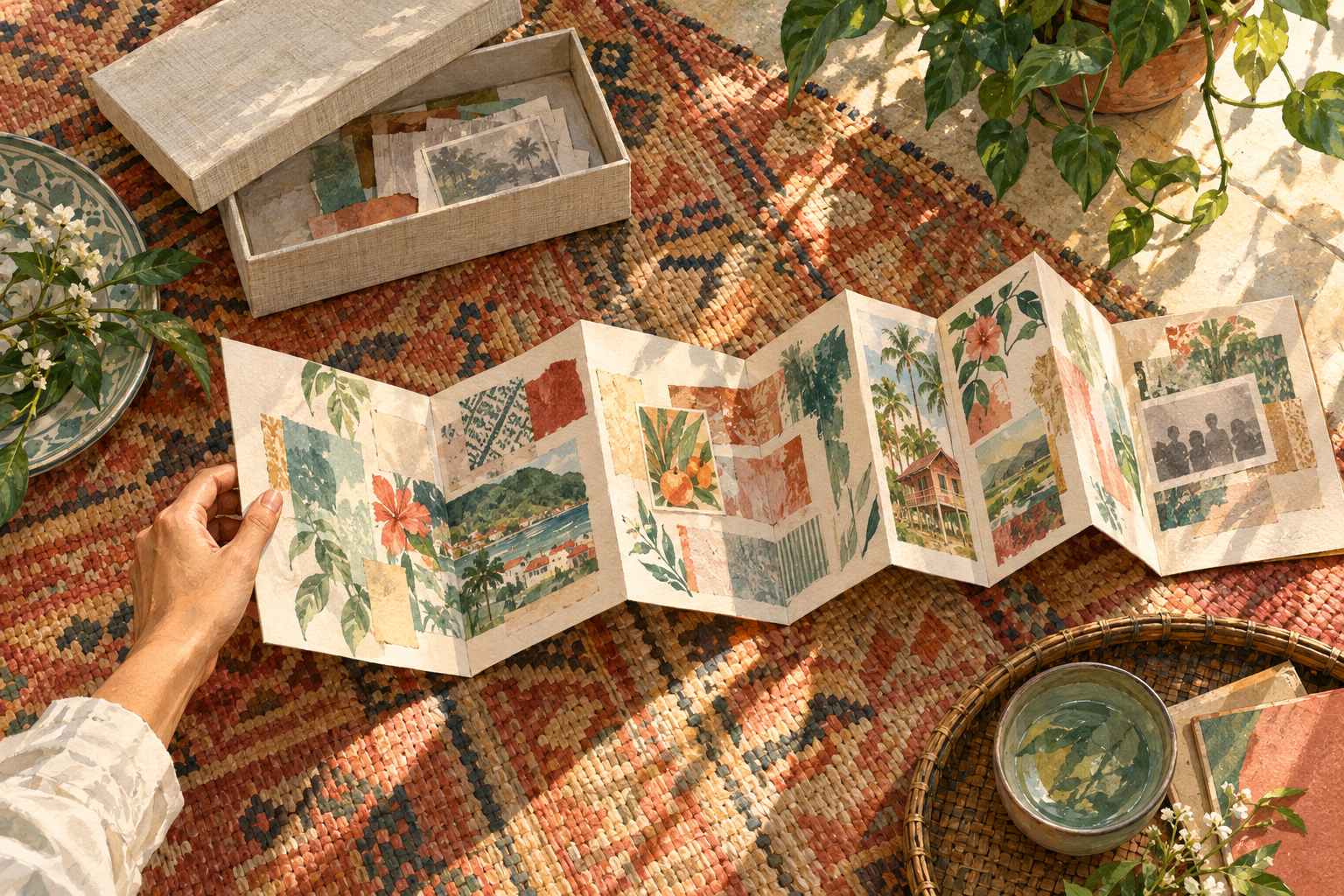
A book does not always have to open like a book. One of Anne Carson’s works comes in a box, unfolds like an accordion and carries the traces of a brother she lost.
Carson has just won the 2026 Nobel Prize in Literature. The Swedish Academy announced the Canadian writer’s award on 8 October, recognising a body of work that brings classical literature into daring new forms.
If the words Nobel literature make you picture a row of very solemn novels, Carson offers another way in. Her work includes poetry, translation, essays and books whose physical form helps tell the story.
A memorial that opens across the room
New Directions describes Nox as a reproduction of a handmade book Carson created after her brother died. The published edition uses accordion folds inside a box, preserving the feel of an object assembled from fragments.
Its material includes family photographs, letters, collage and sketches. Alongside those pieces is Carson’s translation of a poem by the Roman writer Catullus, himself mourning a brother.
The relationship between the old poem and a modern family loss gives the unusual format its weight. This is not simply a surprising package for a poem: private remnants and an ancient text occupy the same unfolding space.
Imagine encountering a remembered life in pieces rather than a neat account running from childhood to adulthood. That is a useful way to approach the object without expecting it to behave like a conventional biography.
The ancient world is part of her working life
Carson is a classicist as well as a writer. The MacArthur Foundation’s profile records her undergraduate and postgraduate study at the University of Toronto, including a doctorate completed in 1981.
The Academy’s biographical material places Greek and Latin literature throughout her career. Its bibliography includes her work on Sappho, Sophocles and Euripides, alongside books written in her own voice.
You do not need to arrive knowing those writers to notice what she is doing. An old text can become a companion to a modern feeling, rather than a historical object left safely behind glass.
That makes her books approachable through a question or an image. What happens when a Roman poem about bereavement sits beside family photographs? What might a myth look like if its central figure had a camera?
A red, winged character becomes a photographer
Autobiography of Red takes another route into the classical world. Penguin Random House presents it as a novel in verse that reworks the Greek myth of Geryon.
Carson’s Geryon is a young, red, winged character who becomes a photographer. His relationship with Herakles belongs to a story that mixes a recognisable emotional life with a figure drawn from myth.
The phrase novel in verse can sound intimidating before you see what it promises: a story told through poetry, rather than a rule that you must stop at every line to solve it.
For a curious reader, the character is an easier starting point than a debate about genre. Follow Geryon and the relationships around him. Let the form reveal how the story moves, instead of deciding in advance what a proper novel should look like.
Another box contains 22 small books
Carson’s collection Float offers a different invitation. In her interview with The White Review, it is described as 22 chapbooks held in a transparent box, with no single required reading sequence.
That changes a very ordinary reading habit. Usually, you turn the next page because the binding has already settled the order for you. Here, choosing the next small book is part of the encounter.
You could begin with a different piece from someone reading the same collection. The physical arrangement leaves room for those routes without making one reader responsible for finding a secret correct order.
The format also makes a useful comparison with Nox. Both use a box, but one opens into a continuous fold while the other holds separate pieces. The container alone does not tell you how the writing will work.
Wrong Norma does not force everything into one story
New Directions describes Wrong Norma as 25 pieces of poetic prose. Its subjects range widely, and the publisher explains that the pieces are deliberately not linked together in a conventional arrangement.
The book includes images by Carson as well as writing. Rather than asking every piece to serve one uninterrupted plot, it allows the collection to retain its different subjects and movements.
For readers used to a novel’s clear beginning and finish, that can offer a different kind of pleasure. You can pay attention to an individual piece without immediately demanding that it explain the whole collection.
It is also a reminder that her experiments are not confined to elaborate packaging. A book can question the expected connections between its parts even when you encounter it through ordinary printed pages.
Start with the form that makes you curious
Penguin Random House’s award announcement describes Carson as a poet, essayist, translator and classicist, with a career already recognised by major literary honours. The Nobel gives that work a new occasion for readers to discover it.
There is no need to turn that occasion into homework. Someone drawn to a family memorial might begin by looking into Nox. A reader who wants characters and a relationship could investigate Autobiography of Red instead.
Float may appeal to anyone intrigued by choosing an order, while Wrong Norma offers a collection whose pieces keep their independence. These are different entrances into the same writer’s work, rather than steps in a compulsory reading course.
The folded book remains a striking place to begin. Open a box, find fragments of a life, and discover that an ancient poem about a lost brother can sit beside a modern photograph. Sometimes the shape of the book is already part of what it wants to say.
Sources & further reading
Prepared with AI assistance from linked reporting. The cover is an AI-generated editorial illustration. Spotted something we should correct?