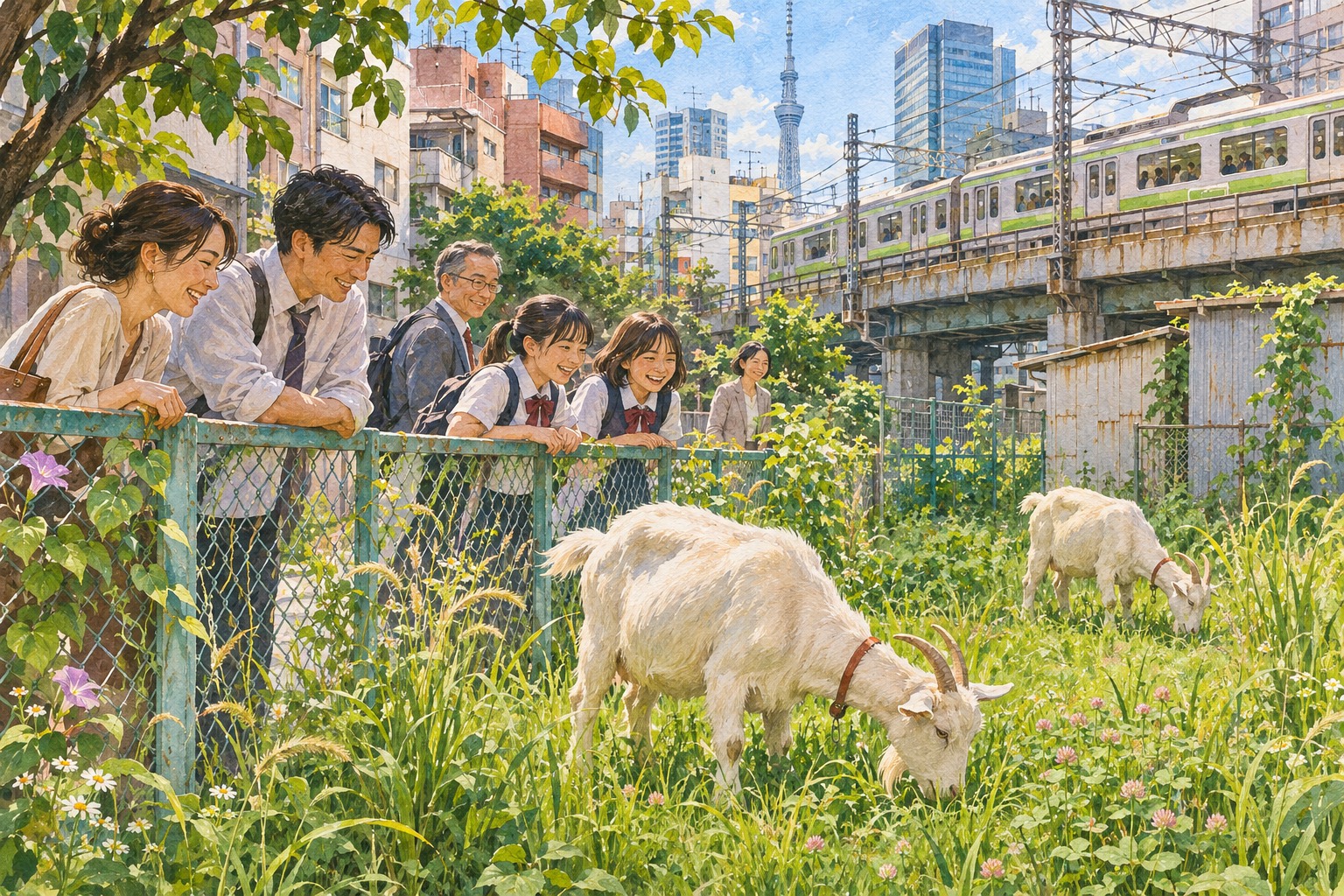
Tokyo office workers are spending their lunch breaks watching somebody else eat. The diners are Nagi and Pokke, two white goats hired to clear weeds from an empty lot near JR Yotsuya Station.
East Japan Railway says grazing offers a natural alternative to grass cutters and herbicides. The experiment began on 9 October in a 900-square-metre plot in Shinjuku and is scheduled to continue until around December — or until the goats finish the grass.
A maintenance trial became a small city attraction
Nagi is a one-year-old male and Pokke is a two-year-old female. Their temporary workplace sits in a dense commercial district, where nearby employees, schoolchildren and other visitors have stopped to see them.
JR East has used goats in similar trials elsewhere, but says this is its first inside the Yamanote line, the rail loop surrounding central Tokyo. The company argues that continuous grazing can reduce the environmental impact associated with mechanical cutting and herbicide use.
That does not mean goats are a universal replacement for landscaping crews. A project must account for animal welfare, fencing, supervision, water, shelter, unsuitable plants and the condition of the site. JR East’s trial concerns one controlled plot, not every railway verge in Japan.
The goats leave when the work is done
Visitors may find the scene calming, but Nagi and Pokke are not a permanent petting zoo. The stated end point is practical: December or the moment the grass has been fully eaten.
The animals’ popularity gives the railway company an unexpected public-facing benefit, yet the useful result will be whether grazing controls vegetation safely and with less environmental impact.
For now, the odd little contrast is enough to stop commuters: trains and offices moving at Tokyo speed, while two goats work through the vacant lot one mouthful at a time.
Sources & further reading
Prepared with AI assistance from linked reporting. The cover is an AI-generated editorial illustration. Spotted something we should correct?