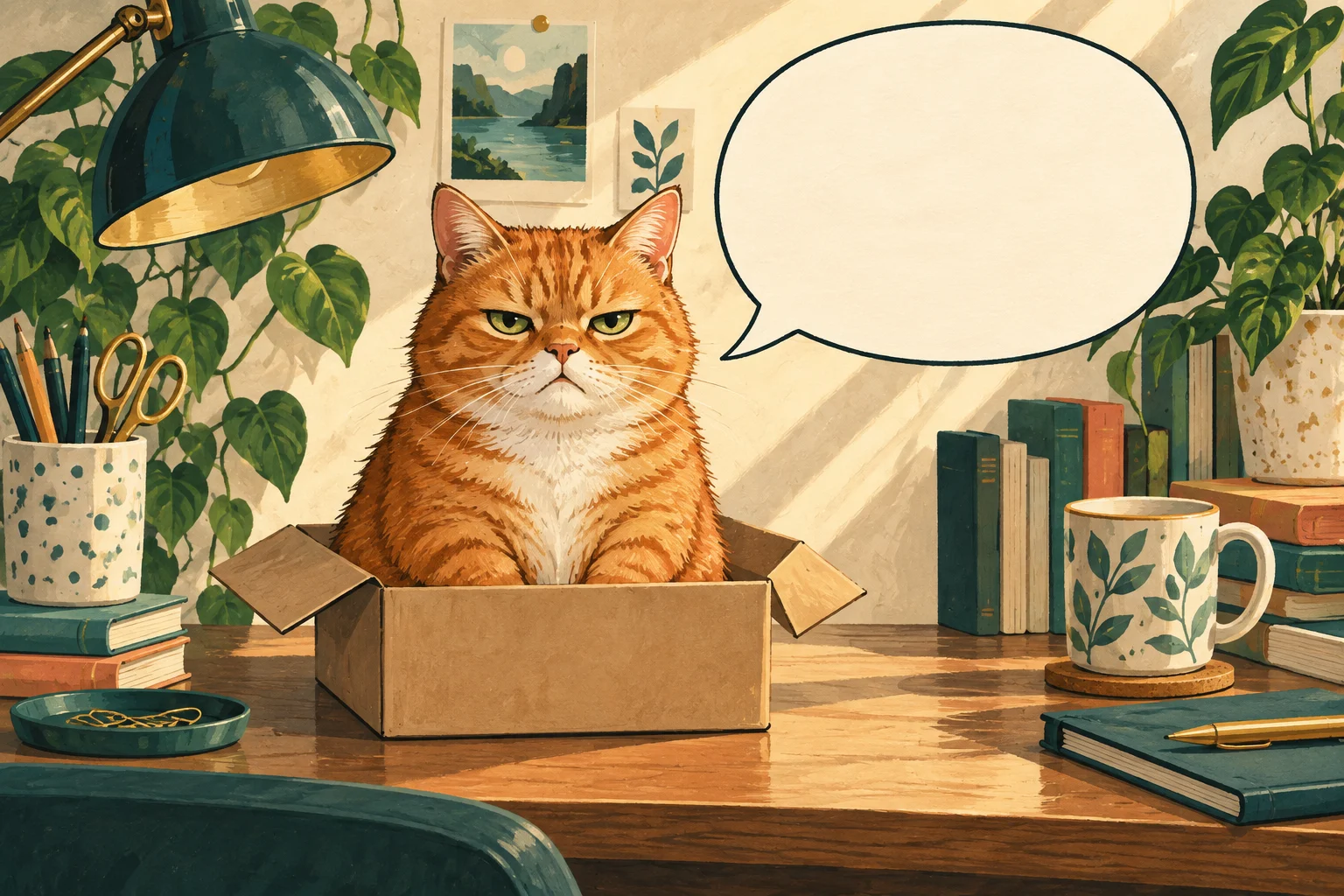
A cat sits in a box. Nothing catches fire. Nobody performs an impressive trick. The cat appears to have a serious appointment somewhere else, but for now it is staying exactly where it is.
Someone adds a caption. Someone else sends the picture to a group chat. Within seconds, several people who were busy a moment ago are discussing a creature whose main contribution is remaining seated.
Why can something so ordinary feel so entertaining? There is no need to reduce every cat picture to a single scientific explanation. As a piece of everyday internet humour, though, it offers a few enjoyable clues about what we notice and what we bring to an image ourselves.
We supply the story the cat never agreed to tell
Look at a still image and the expression seems obvious. This cat is disappointed. That one has seen the electricity bill. Another is silently judging the person who chose the curtains.
Those are human interpretations. The photograph alone does not tell us the animal's thoughts. Yet the gap between the actual scene and the imagined situation is where a lot of the humour lives.
A face or posture gives the viewer a starting point. A caption supplies the rest. Suddenly a cat beside a laptop looks like an employee refusing another meeting, even though the animal has no idea what a meeting is supposed to involve.
The joke is a collaboration between the picture, the person adding the words and the audience recognising the situation. The cat can continue doing nothing because everybody else is doing the storytelling.
The lack of action can become the whole event
A busy feed contains people announcing, explaining, reacting and asking you to keep watching. An image of an animal sitting still makes a very small demand by comparison. You can understand the scene before deciding whether to spend another second with it.
That can be part of its appeal. The image does not require a complicated backstory. A box, a face and an oddly committed posture can be enough material for a joke.
Sometimes the funny part is the contrast between a dramatic caption and an undramatic picture. A person describes a major crisis; the cat remains a neat, motionless shape. The joke does not need an elaborate ending because the mismatch is already there.
And sometimes there is no clever explanation at all. A friend finds the picture funny, their reaction makes you laugh, and that shared moment becomes more memorable than the original image.
A group chat gives an ordinary picture a personal meaning
The same photograph can land differently in different conversations. In one chat, it resembles somebody waiting for lunch. In another, it recalls a colleague's favourite expression. In a third, it becomes the response to a running joke that would make no sense outside the group.
That personal context matters. You are not only reacting to a cat. You are recognising the person who sent it and the little history of the conversation around it.
A message can also be a low-pressure way of saying hello. Sending an amusing image asks less of someone than demanding a full update about their day. They can respond with a smile, another image or nothing at all.
There is warmth in that small invitation when it fits the relationship. Of course, timing still counts. A joke that is welcome in a relaxed chat may be distracting in a conversation about something serious.
Captions can change the whole reading
Try imagining one picture with three different captions. A cat staring past the camera could be waiting patiently, plotting an escape or regretting a decision about dinner. The image has not changed, but your interpretation has.
That makes cat humour a gentle demonstration of how much context shapes a picture. It is easy to notice when the stakes are low and the explanation is deliberately absurd.
The same habit is useful elsewhere in a feed. A caption can suggest a location, a cause or an emotion that an image does not independently establish. When the picture concerns a real event or person, check the source rather than treating the accompanying words as evidence.
Enjoying a joke and noticing how it works can happen together. You do not have to stop laughing to recognise that somebody has supplied the story.
The animal should not have to pay for the joke
A relaxed animal photographed during an ordinary moment is a different proposition from one being frightened or forced into an uncomfortable setup. Before sharing a clip, look at how the scene appears to have been created.
If the entertainment depends on provoking a reaction, it is reasonable to pass. You can choose content that does not require an animal to be distressed for your amusement.
Be careful about claiming you know an animal's condition from a short clip too. A few seconds can leave important context out. You do not need to diagnose the situation to decide that a video makes you uncomfortable and is not something you want to circulate.
For your own pictures, let the pet's comfort determine the moment. An unremarkable nap can be perfectly good material. There is no need to arrange a spectacle when the joke is supposed to be how little is happening.
A small laugh is allowed to stay small
Not every amusing image needs to become a theory about modern life. Sometimes a cat looks oddly solemn, a caption catches you at the right moment and the result is a brief laugh between other tasks.
You can appreciate that without turning the picture into proof that everybody loves the same thing. Humour depends on the person, the context and the day. A joke that delights one friend may leave another entirely unmoved.
What is interesting is how little material a shared moment can need. One image can become an invitation to notice something ordinary together, then return to whatever you were doing.
The cat remains in the box. The group chat moves on. For a minute, a creature doing absolutely nothing has given several people something to talk about. That is a modest achievement, but a very good one for somebody who never intended to participate.